Seven Reasons Mindful Eating Stops Working After a Few Weeks
Quick Answer: Mindful eating fades because it is usually practised as a rule rather than a skill - and rules require attention, which is exactly what runs out. The seven common failure points are: treating it as a diet, practising only at difficult meals, ignoring hunger levels before eating, removing distraction without replacing it, expecting weight loss, undereating earlier in the day, and having no plan for social meals. The single highest-leverage fix is arriving at meals moderately hungry rather than ravenous, because willpower cannot compete with genuine hunger.
Each reason below has a fix that takes less effort than the practice you were already trying to sustain.

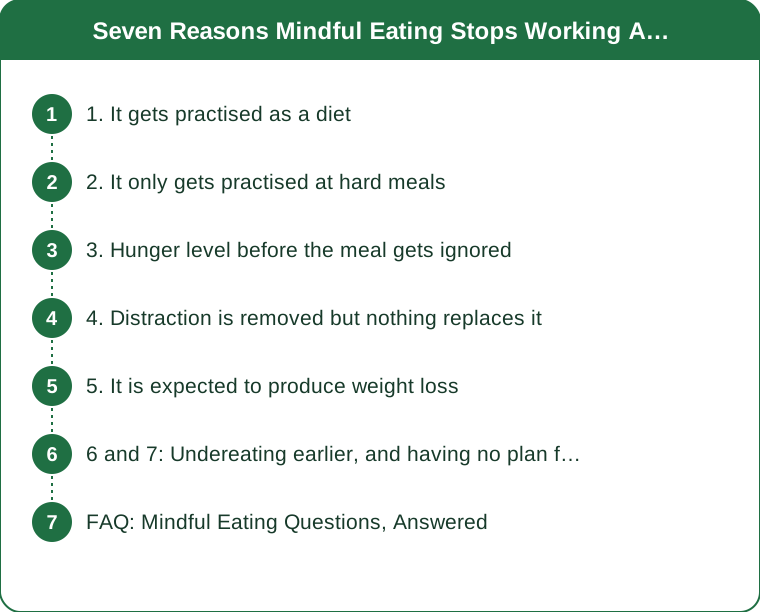
1. It gets practised as a diet
The most common failure, and the one that guarantees the rest.
Mindful eating is a set of attention skills, not a set of food restrictions. When it gets used as a covert diet - eating slowly so that you eat less - the entire mechanism inverts.
The restriction creates the preoccupation that mindfulness was meant to reduce. You end up paying close, anxious attention to food, which is a very different experience from paying curious attention to it.
And it sets up a pass/fail structure. A meal eaten quickly becomes a failure, failures accumulate, and the practice gets abandoned.
The fix: separate the goals explicitly. If you want to change what you eat, do that as a deliberate nutrition decision. Use mindful eating to change how you eat, and judge it on attention rather than on outcome.
A concrete reframe: the aim of a mindful meal is to be able to describe the food afterwards. That is the whole success criterion - not how much was left on the plate.
2. It only gets practised at hard meals
People try it at the meal they most want to change, which is the worst possible place to learn.
The 9pm biscuit episode is the hardest context available - tired, depleted, often emotionally loaded. Trying to build a new skill there is like learning to swim in a current.
Skills need to be built in easy conditions first. Breakfast on a quiet morning. A cup of tea. The first three bites of lunch.
The fix: practise the first three bites of a meal you are not worried about, every day, for two weeks. Notice temperature, texture, and how the flavour changes.
Then extend it. Once the skill is automatic in easy conditions, it is available in hard ones. Trying the reverse order is why most attempts fail in week three.
3. Hunger level before the meal gets ignored
This is the mechanical one, and fixing it does more than all the attention practice combined.
Arriving at a meal ravenous overrides everything. Extreme hunger drives fast eating and large portions through mechanisms that are not about attention at all - you cannot mindfully out-attend a genuine physiological drive.
Use a simple 1 to 10 hunger scale. Aim to start eating around 3 or 4 - clearly hungry, not desperate. Below 2, mindful eating is essentially unavailable.
The fix is usually earlier in the day. A skipped or under-protein breakfast produces a 4pm crash and a 7pm scramble. 30 to 40g of protein at each of the earlier meals removes the evening problem far more reliably than evening discipline does.
Check hunger before you plate, not after. A ten-second check before serving changes portion decisions more than any plate-size trick.
And notice the reverse case: eating at a 6 or 7 on the hunger scale - not really hungry - is where the practice becomes genuinely informative, because whatever is driving that meal is not hunger, and paying attention reveals what it is.

4. Distraction is removed but nothing replaces it
Taking the phone away leaves a gap, and the gap is uncomfortable.
People eat with distraction for a reason. It fills silence, manages boredom, and softens difficult feelings. Removing it without a replacement makes meals feel worse, and the practice gets dropped.
The fix is to give the attention a job. Not be present in the abstract, but a specific task: name three flavours, notice when the taste intensity starts to drop, or count how many times you put the fork down.
A concrete anchor that works: put the utensil down between bites for the first five bites. It is a physical action rather than a mental state, which makes it far easier to actually do.
Sensory-specific satiety is the interesting thing to notice. The pleasure of a particular food genuinely declines as you eat it - often measurably by the third or fourth bite. Noticing that decline is what naturally shifts eating toward enough, without a rule being involved.
And meals with other people count as engaged, not distracted. Conversation slows eating and is a legitimate form of attention.
5. It is expected to produce weight loss
It sometimes does, unpredictably, and expecting it undermines the practice.
The evidence for mindful eating and weight is mixed. It shows more consistent effects on binge eating, emotional eating, and eating-related distress than on body weight.
Weighing the practice against the scale creates the diet dynamic that reason one described, and it usually ends the same way.
The fix: choose non-weight measures. Number of meals eaten without a screen. Whether you can describe what dinner tasted like. Frequency of eating past comfortable fullness. These respond within weeks and they are the things the practice actually influences.
If weight change is a goal, address it directly and separately - and note that mindful eating pairs perfectly well with a deliberate nutrition plan. The mistake is asking one tool to do both jobs covertly.
6 and 7: Undereating earlier, and having no plan for social meals
6. Undereating earlier in the day
The evening problem is usually a morning problem wearing a disguise.
A light breakfast and a small lunch produce an energy and hunger debt that arrives around 4pm and gets paid at 8pm, with interest.
Protein and fibre are the two levers. 30 to 40g of protein at breakfast and lunch substantially flattens the evening drive, and fibre from vegetables, legumes, and whole grains extends satiety further.
Under-eating also degrades attention itself. Low blood glucose reduces the cognitive capacity that mindful eating requires. You are asking for careful attention at the exact moment you have least available.
The fix is unglamorous: eat a proper breakfast and a proper lunch. A large number of evening eating problems resolve without any evening intervention at all. And watch for the accidental version - busy days where lunch is a coffee and a snack bar are not a diet decision, they are an unplanned deficit that gets corrected automatically after dark.
7. No plan for social and disrupted meals
The practice works at home and collapses everywhere else, which is most of real life.
Restaurant meals, family dinners, and events have different rules - larger portions, slower service, alcohol, and social pressure. A practice built only for solo meals has no version for these.
The fix is a scaled-down version rather than an abandoned one. Three bites of attention at the start of the meal, and one hunger check halfway through. That is it.
Alcohol deserves a specific note. It reduces interoceptive awareness and disinhibits eating. This is not a reason to avoid it - it is a reason not to expect the same practice to work, and to plan accordingly.
Autumn and winter increase the frequency of these meals sharply. More gatherings, more shared food, more disrupted routine. A practice that only works in January conditions will not survive December, which is why building the scaled version now matters.
And the general principle underneath all seven: mindful eating is a skill that degrades under load, like any other. The answer is not more determination but lower-effort versions that survive a bad week - three bites and one hunger check, on the worst day of the year, is a practice that is still running.
This is general information, not medical advice. If eating feels distressing or out of control, that is worth discussing with a doctor or a registered dietitian.
FAQ: Mindful Eating Questions, Answered
Is mindful eating supposed to help me lose weight?
The evidence is mixed for weight and more consistent for binge eating, emotional eating, and eating-related distress. Expecting weight loss tends to turn it into a diet, which is the most common way it fails.
How do I start if I keep forgetting?
Practise only the first three bites of one easy meal a day, with a physical anchor like putting the fork down between bites. Physical actions are far more repeatable than mental intentions.
Why does it fall apart in the evening?
Usually because of under-eating earlier in the day. Adding 30 to 40g of protein at breakfast and lunch resolves a large share of evening eating without any evening strategy at all.
Can I practise it while eating with other people?
Yes - conversation counts as engagement rather than distraction, and it naturally slows eating. Use a shortened version: attention for the first few bites plus one hunger check midway.
What is the hunger scale?
A 1 to 10 rating of physical hunger. Starting meals around 3 or 4 - clearly hungry but not desperate - is where the practice is actually possible. Below 2, physiology overrides attention.
What if eating feels out of control?
That is worth raising with a doctor or a registered dietitian rather than addressing alone. Mindful eating is a useful skill but it is not a treatment for disordered eating.
TL;DR:
- Mindful eating fades because it is practised as a rule rather than a skill, and rules need attention you eventually run out of.
- Arrive at meals around 3 or 4 on a 1 to 10 hunger scale - this single change matters more than all the attention practice.
- Practise at easy meals first (the first three bites of breakfast), not at the 9pm episode you most want to change.
- Replace distraction with a specific job - name three flavours, put the fork down between bites - rather than removing it and leaving a gap.
- Judge it on attention, not the scale, and keep a scaled-down version for social meals so it survives the autumn and winter season.
The most useful reframe is that this is a skill with a bad-day version, not a standard you either meet or fail. Three bites and one hunger check is a practice that is still running.
This is general information, not medical advice.
Keep Reading
This article is for general informational purposes only and is not medical advice. Always consult a qualified health professional for guidance specific to you.