7 Reasons Standing Up to Eat Changes How Much You Eat
Quick Answer: Standing to eat reliably shortens meals, reduces attention to the food, removes the natural end-point that sitting provides, and makes portions harder to judge. The effect is less about posture and more about context: standing meals are almost always unplanned, unportioned and interrupted. Most people eat faster and register the meal less, and a meal you do not register does not count toward feeling fed.
You did not sit down. You just ate the leftovers over the sink while checking your phone, and half an hour later you are looking for something else.
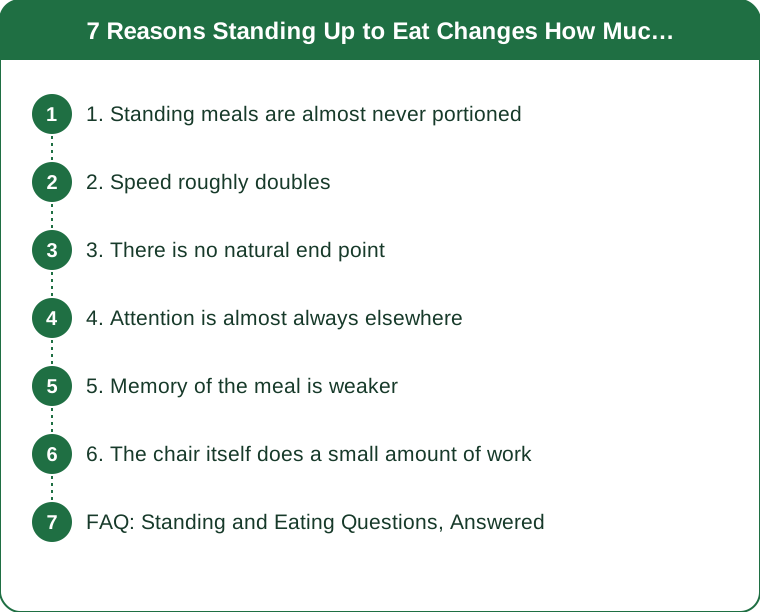
Here are the seven mechanisms behind that, in order of how much they matter.

1. Standing meals are almost never portioned
The single biggest factor, and it has nothing to do with your legs.
Sitting down implies a plate. Standing implies a container, a pan, or the packet. Nobody stands at the counter and serves themselves a measured portion, because the whole appeal of the standing meal is skipping that step.
Eating from a shared container removes the visual reference point that portion judgement depends on. Research on eating from large versus small packages consistently finds people eat more from larger containers without noticing, sometimes substantially more.
The fix is trivial and effective: if you are going to eat standing up, put it on a plate first. It takes eight seconds and restores the reference.
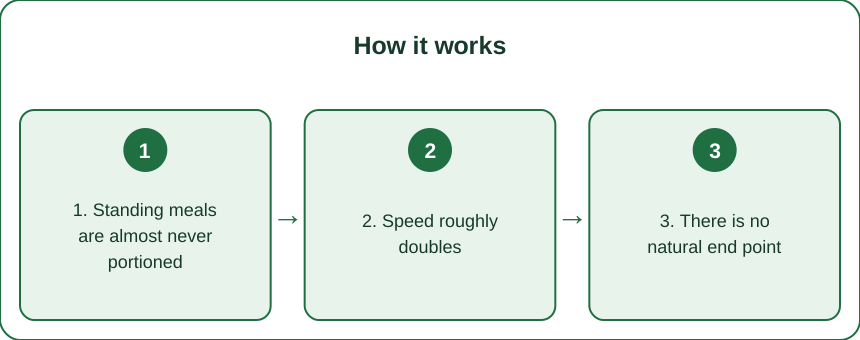
2. Speed roughly doubles
Standing meals are short. That is usually why they happen.
The satiety signalling system runs on a delay. Gut hormones including CCK, GLP-1 and PYY rise over roughly 15 to 20 minutes after eating begins. Anything eaten inside that window is eaten without feedback.
A seated meal typically takes 15 to 25 minutes. A standing meal often takes five to eight. You finish before the system that would tell you to stop has said anything.
This is the mechanism behind most fast-eating research findings, and it is why speed correlates with intake far more reliably than any specific food does.
3. There is no natural end point
A seated meal ends. You finish what is on the plate, you put down the fork, you push back the chair. These are physical markers and the brain uses them.
Standing at a counter, there is no plate to finish and no chair to leave. You take a few bites, do something else, come back, take a few more. The meal has no boundary, so it does not get filed as a meal.
This produces the specific and common experience of eating a full meal’s worth of food and then genuinely feeling like you have not eaten. You have not had a meal. You have had a series of bites, and episodic memory of eating is a real input into later hunger.

4. Attention is almost always elsewhere
Standing meals are multitasked by definition. Phone, laptop, cooking something else, tidying.
Distracted eating has been studied extensively and the findings are consistent: distraction during a meal increases intake at that meal and, more interestingly, at the next one. Memory of what you ate appears to be part of how appetite is regulated later in the day.
Standing does not cause distraction, but it correlates with it almost perfectly. Sitting down is a signal to yourself that this is the activity, not the background to another one.
5. Memory of the meal is weaker
Related to the point above, and worth its own line because the effect is larger than intuition suggests.
Studies have found that people with impaired recall of a recent meal eat more at the next opportunity, and that prompting people to recall what they ate reduces later intake. Meal memory functions as an appetite input.
A standing, distracted, unportioned meal is close to the worst case for encoding. There was no plate, no defined start or end, and your attention was elsewhere.
The practical implication: the thirty seconds it takes to look at your food before eating it is not a mindfulness affectation. It is what makes the meal memorable enough to count.
6. The chair itself does a small amount of work
Setting aside context, does posture matter on its own? A little.
Gastric emptying is modestly slower when upright than lying down, and there is some evidence that posture influences digestion rate, though the direction and size are not dramatic. The physiological effect of standing is small compared to the behavioural effects.
There is one genuine ergonomic point though. Eating while standing usually means holding a container in one hand and eating with the other, which encourages larger, faster bites and less chewing. Chewing count correlates with satiety in several studies.
So the posture contributes, but if you sat down and still ate from the container in six minutes while scrolling, you would get most of the same result.
7. It reinforces the idea that eating is not worth stopping for
The habit effect, and over months it may be the most important of the seven.
Every standing meal teaches you that food is something to be fitted around other things. That framing generalises. People who habitually eat standing tend to snack more, not because standing causes snacking, but because both come from the same underlying stance toward eating.
The reverse also generalises. Sitting down for four minutes with a plate, without a screen, does more than improve that one meal. It reestablishes eating as an event that has a beginning and an end, which is the structure that most eating regulation quietly depends on.
What is the minimum viable version?
Plate, chair, no screen, four minutes. Not a ritual, not a long meal. Almost all the benefit is in the first few minutes of doing it properly.
FAQ: Standing and Eating Questions, Answered
Is standing to eat actually bad for you?
Not inherently. The concern is entirely about the context that usually comes with it. A properly portioned, unhurried, undistracted standing meal is fine.
What about eating at a standing desk?
Same answer, with the added risk that a work standing desk almost guarantees distraction. If you eat there, close the laptop for the duration.
Does this apply to snacks too?
More so, if anything. Standing snacks from a packet combine every factor on this list at once, which is why they are so easy to underestimate.
I genuinely do not have time to sit down.
Four minutes seated with a plate is usually available even on a hard day, and it typically prevents the fifteen minutes of grazing that follows an unsatisfying standing meal. It is often a net time saving.
This is general information, not medical or nutritional advice.
TL;DR:
- Standing meals are unportioned, roughly twice as fast, and have no defined end point, so they finish before satiety signalling begins.
- They are almost always distracted, which increases intake both then and at the next meal.
- Weak meal memory is a real appetite input, and a standing counter meal is the worst case for encoding one.
- Posture itself contributes only a little. The context does nearly all the work.
- Minimum fix: plate, chair, no screen, four minutes.
If you change one thing from this list, make it the plate. It restores the portion reference, creates an end point, and makes the meal memorable, which is three of the seven mechanisms for eight seconds of effort.
Keep Reading
This article is for general informational purposes only and is not medical advice. Always consult a qualified health professional for guidance specific to you.