7 Reasons You Eat More When You Are Cold
Quick Answer: Cold raises appetite through several independent mechanisms at once: your body burns more energy maintaining core temperature, cold exposure directly stimulates appetite signalling, less daylight affects serotonin and carbohydrate craving, and warm food is more appealing and typically more calorie-dense. Most of the increase is physiological rather than a discipline problem, and it usually amounts to 100 to 300 calories a day.
Nothing changed. Same routine, same meals, same portions.
Except it is now 12 degrees in the morning instead of 24, and you are somehow hungry at 4pm in a way you were not three weeks ago.

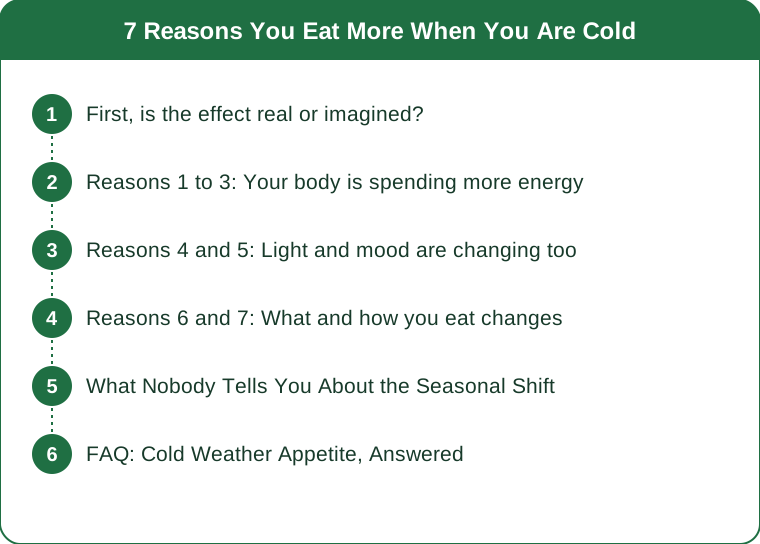
First, is the effect real or imagined?
Real, measurable, and larger than most people assume.
Studies of seasonal eating patterns consistently find higher energy intake in colder months — commonly 86 to 200 or more additional calories per day, depending on the population and the climate. It shows up in food diaries, in supermarket purchasing data, and in laboratory cold-exposure studies.
It is also not a modern quirk. Seasonal appetite variation is well documented across species and is thought to reflect an adaptive response to colder, historically leaner months.
What this means practically: if you feel hungrier as autumn arrives, you are describing a real physiological change, not a failure of resolve. That reframing matters, because treating a normal seasonal shift as a discipline problem tends to produce restriction, then rebound, then guilt — a cycle that reliably makes eating less mindful rather than more.
The seven mechanisms below are largely independent, which is why the combined effect is noticeable.
Reasons 1 to 3: Your body is spending more energy
1. Thermoregulation costs real calories
Maintaining 37 degrees in a colder environment requires energy. Mild cold exposure raises metabolic rate modestly; shivering raises it dramatically — up to five times resting rate in intense cold. Even the sub-shivering thermogenesis of a chilly office or a cold commute has a cost, and your appetite is reasonably good at noticing it.
2. Brown fat activation increases energy use
Cold activates brown adipose tissue, which generates heat by burning energy directly. Adults have less than infants but enough to matter, and it is more active in colder months. More energy expended reliably produces more hunger — the system is designed to close that gap.
3. Cold exposure directly stimulates appetite signalling
This is separate from the energy cost. Cold exposure influences the hormonal signals governing hunger, including ghrelin, independently of how many calories you actually used. This is why swimming in cold water produces ravenous hunger out of proportion to the exercise involved. Your body responds to the temperature itself, not just the deficit.
Reasons 4 and 5: Light and mood are changing too
4. Less daylight affects serotonin and carbohydrate craving
Shorter days reduce light exposure, which affects serotonin levels. One well-supported response is increased craving for carbohydrate, because carbohydrate intake facilitates tryptophan uptake and supports serotonin production. This is the mechanism behind the specific craving for bread, pasta and baked goods rather than a general increase in appetite — and it explains why the autumn shift feels targeted rather than uniform.
5. Lower mood and lower activity compound each other
Autumn brings less outdoor time, less light, and for many people a mild mood dip. Food is a reliable and immediate mood regulator, so eating-for-comfort increases at exactly the point when activity decreases. Fewer steps and more comfort eating arrive in the same fortnight, and each makes the other more likely. This one is worth naming clearly, because it is the mechanism most responsive to a deliberate change.

Reasons 6 and 7: What and how you eat changes
6. Warm food is more appealing and more calorie-dense
Cold weather shifts preference toward hot food, and hot food skews heavier — stews, roasts, pasta, baked things. A summer lunch of salad and cold protein might be 400 calories; the autumn equivalent of soup with bread and cheese is closer to 650. Nothing about your portion sizes changed. The menu did. This is probably the largest single contributor of the seven.
7. You eat indoors, seated, for longer
Summer eating is fragmented — outdoors, standing, on the move, in daylight. Autumn eating happens at a table, indoors, often in front of a screen, and lasts longer. Longer meals with more distraction produce more food eaten before fullness registers. The setting changed, and setting is one of the strongest determinants of how much anyone eats. The same meal in a different context genuinely produces a different quantity.
What Nobody Tells You About the Seasonal Shift
Some of the increase is appropriate and should not be fought. If you are genuinely spending more energy staying warm, eating more is the correct response. The goal is matching the increase to the actual need, not resisting it wholesale.
Warmth is an appetite intervention. Being cold indoors drives eating, and simply being warmer — a jumper, a blanket, a hot drink — reduces it measurably. This is the single most underused fix, and it costs nothing to test.
A hot drink genuinely helps. Warmth plus volume plus a pause. It is not a trick or a substitute for food; it addresses two of the seven mechanisms at once.
Protein and volume matter more now than in summer. Autumn cravings skew carbohydrate-heavy, which is fine, and pairing them with protein and vegetables changes how long they hold you. Soup with beans and vegetables satisfies far longer than soup alone.
Light exposure in the morning is worth more than it sounds. Twenty minutes of daylight early affects both mood and circadian timing, and it addresses reason four at the source rather than managing its consequences.
And the fourth mistake surprises people: most seasonal weight change comes not from eating more but from moving less. Steps commonly drop by 20 to 30 percent from summer to autumn, which is often the larger half of the equation.
FAQ: Cold Weather Appetite, Answered
How many extra calories are we actually talking about?
Studies typically find 86 to 200 or more calories a day, with wide individual variation. If you are outdoors a lot in genuinely cold conditions, it can be considerably higher and entirely justified.
Does this mean I will gain weight every winter?
Not necessarily. Modest seasonal fluctuation of a kilo or two is common and reverses in spring for most people. The pattern worth watching is the year-on-year drift where each winter’s gain does not fully reverse.
Is craving carbohydrate specifically a real thing?
Yes, and it has a plausible serotonin-linked mechanism behind it. Treating it as a signal to include some quality carbohydrate rather than to eliminate it entirely usually works better, since strict restriction tends to intensify the craving.
What is the one change worth making?
Get warm before you decide you are hungry. Put on a layer, make a hot drink, wait ten minutes. A meaningful share of autumn hunger is temperature, and this separates the two in the only way that actually tells you which is which.
TL;DR:
- Cold weather appetite is real — typically 86 to 200+ extra calories a day — and mostly physiological rather than a willpower issue.
- Thermoregulation, brown fat activation, and direct cold-driven appetite signalling account for the biological half.
- Less daylight drives carbohydrate craving specifically, and warmer, denser food plus longer indoor meals account for the behavioural half.
- Moving less is often the bigger contributor to seasonal weight change than eating more.
Next time hunger arrives at an odd hour, put on a jumper and make a hot drink first. Ten minutes later you will know whether it was hunger or temperature, and you will be right more often than you expect.
Keep Reading
This article is for general informational purposes only and is not medical advice. Always consult a qualified health professional for guidance specific to you.