7 Reasons Eating in the Same Spot Changes How Much You Eat
Quick Answer: Where you eat sets a default portion before you take the first bite. Location cues learned over months tell your brain what a normal amount looks like there, and the physical setup — chair height, sightlines, distance to seconds — decides how easy it is to stop.
Most eating advice targets the food. Almost none of it targets the twelve square feet the food gets eaten in.
That is backwards, because the room is doing more work than the willpower is.
This is general information, not medical advice.

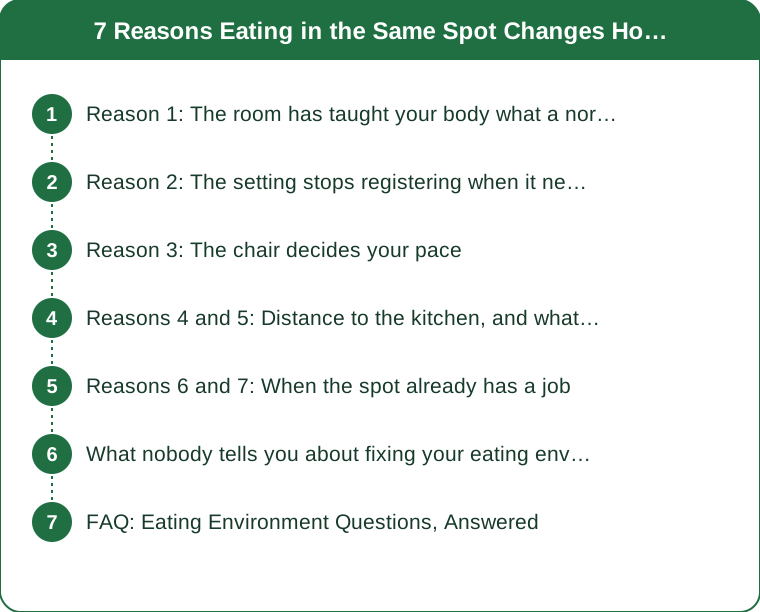
Reason 1: The room has taught your body what a normal portion is
Repetition builds an expectation. Eat dinner in the same chair four hundred times and that chair carries a learned portion size — not a decision you make each night, but a default your brain arrives with.
This is ordinary associative learning, and it is why the same person eats a modest amount at a kitchen table and a much larger amount on the couch without either feeling like a choice. The couch was trained by different meals: movie snacks, second helpings, evenings where the eating went on for two hours.
The practical consequence is that changing the location changes the default faster than trying to override it in place. People who move dinner from the couch to a table often report the portion adjusting within a week or two, with no conscious restriction. The cue moved, so the expectation moved.
Does that mean I should keep changing where I eat?
No — the opposite. You want one consistent spot with the default you actually want, not constant novelty. Variety keeps the cue from ever settling.
Reason 2: The setting stops registering when it never changes
There is a tension inside reason one, and it is worth naming.
A fixed location builds a helpful default. It also builds habituation — the setting stops registering as information, and so does the meal inside it. This is the mechanism behind eating a full plate and genuinely not remembering the taste. Nothing about the environment prompted attention, so attention went elsewhere.
The fix is not moving rooms. It is introducing one small variable that requires a beat of noticing: a different plate, a placemat you only use for meals, cutlery you have to go get. A cue that says this is a meal rather than this is the surface where things happen.
What works reliably for people is a setup step: something that takes 30 seconds and marks the start. Laying a placemat, pouring a glass of water, sitting down before the first bite. The step is not virtuous — it is functional. It re-inserts a moment of attention into a routine that had stopped requiring any.
Reason 3: The chair decides your pace
Seat height and back support change eating speed more than most people would guess.
A soft, low seat encourages a reclined posture that makes the meal feel like an activity you are settled into rather than one that will end. A firmer upright chair at a table at standing-elbow height keeps the meal defined — you are doing one thing, and it has a shape.
The measurable difference shows up in duration. Meals eaten upright at a table run longer per bite and shorter overall than meals eaten on soft seating, where the food ends but the sitting does not, and the sitting is where the extra handfuls happen.
Standing is its own case. Eating standing up tends to speed people up considerably — the body reads it as a transitional activity, and transitional eating is fast eating. If you eat lunch standing at a counter most days, that alone is worth changing before anything about the food is.

Reasons 4 and 5: Distance to the kitchen, and what is in your line of sight
Reason 4: Every step to seconds matters more than it should
The effort cost between you and more food is a stronger lever than intention. Serving from the stove and sitting in another room means seconds require standing, walking, and a decision. Serving family style at the table means seconds require a reach.
That gap sounds trivial and is not. Serving plates in the kitchen and bringing only your plate to the table is one of the highest-yield single changes available, precisely because it costs nothing at the moment of temptation — the work was done before you sat down.
Reason 5: Visible food is a running invitation
What sits in your sightline while you eat keeps prompting. A bread basket on the table, the pan still on the stove within view, the snack bowl on the counter behind your seat — each is a small repeated cue during the exact window when your fullness signals are still catching up.
The angle of your chair matters here in a way that feels absurd until you try it. Facing a window or a wall rather than the kitchen removes the prompt entirely. Same food, same portion, different sightline.
Reasons 6 and 7: When the spot already has a job
Reason 6: A desk is a work cue first and an eating surface second
Eating where you work means the dominant association is work, and the meal becomes background to it. Studies on distracted eating consistently find that people eat more during the meal and more at the next one, because the memory of having eaten is weaker.
That second part is the underrated half. It is not only that you ate past full at your desk — it is that the afternoon feels like you have not eaten, because in memory terms you barely did.
Reason 7: The spot triggers the snack, not the hunger
A location that has hosted a snack often enough starts requesting one. Sitting in the TV chair at 8 p.m. produces the impulse to eat regardless of dinner, because the chair is a cue and the cue fires on schedule.
This is the most fixable of the seven, and it does not require giving up the chair. It requires giving the cue something else to resolve into — tea, sparkling water, something that occupies the same slot. The impulse fades in most people within two to three weeks of consistently answering it differently, which is the same timeline as any other cue-response relearning.
What nobody tells you about fixing your eating environment
The advice usually stops at do not eat in front of the TV, which is both correct and useless on its own, because it removes a habit without replacing it.
Three things nobody mentions:
One change at a time works and five do not. People who redesign the whole thing on a Sunday are usually back to the couch by Thursday. Moving dinner to the table and leaving everything else alone survives.
The kitchen counter is the worst spot in most homes and the one nobody thinks about, because it is standing, it is fast, it is next to all remaining food, and it is where the leftover-tasting happens that no one counts as eating.
Your setup only needs to fit the meals you actually eat. If dinner is the meal that runs away from you, fix dinner. Optimizing breakfast when breakfast was never the problem is how people spend three weeks on this and see nothing change.
One more that surprises people: eating with the plate on a table you can see the whole of — not a lap, not a crowded desk — changes how portions register visually. A plate on a lap has no reference frame, and the amount eaten becomes genuinely hard to track.
FAQ: Eating Environment Questions, Answered
Does eating at a table actually reduce how much people eat?
Directionally yes, and the effect appears to run mostly through pace and attention rather than the table itself. The realistic expectation is a modest reduction plus a noticeably clearer sense of having eaten, not a dramatic drop.
What if I genuinely have no space besides my desk?
Then change what you can: turn the chair away from the screen, use a real plate, and put the phone face down. The screen is doing more of the damage than the desk is.
Should I stop eating with the TV on entirely?
If you enjoy it, once or twice a week as a chosen thing is different from it being the default. The pattern to break is unconscious daily repetition, not the occasional deliberate one.
Does this apply to family meals?
Differently. Eating with others tends to extend meals, and longer meals can mean more food — but shared meals also improve satisfaction and pace. Serving from the kitchen instead of the table addresses most of the downside without touching the upside.
How long before a new spot feels normal?
Usually one to three weeks for the setting to stop feeling like an imposition, and closer to a month before the portion default settles. The awkward stretch in the middle is the part most people quit during.
TL;DR:
- Where you eat carries a learned default portion; changing the location resets it faster than fighting it in place.
- Chair type sets your pace — soft seating extends meals, upright seating defines them.
- Serve from the kitchen, not the table; every extra step before seconds does real work.
- Turn your seat away from visible food and away from screens.
- A cue-triggered snack fades in two to three weeks if you consistently answer it with something else.
None of this is about eating less through effort. It is about not spending effort on a setup that was quietly working against you. Fix the room once and it keeps paying out every meal after.
This is general information, not medical advice.
Keep Reading
This article is for general informational purposes only and is not medical advice. Always consult a qualified health professional for guidance specific to you.