7 Signals Your Body Sends Before You Are Full — and Why You Miss Six of Them
Quick Answer: Fullness arrives as a sequence, not an event. Stomach stretch registers within minutes, but hormonal satiety signals take 15 to 20 minutes to reach the brain, and flavor-specific satiety arrives earlier than either. Most people eat past six earlier signals and only stop at the seventh — physical discomfort. Learning to notice the earlier ones is the entire skill.
You are not bad at knowing when you are full. You are waiting for the loudest signal because it is the only one you were ever taught to recognize.
Here are all seven, in the order they actually arrive.

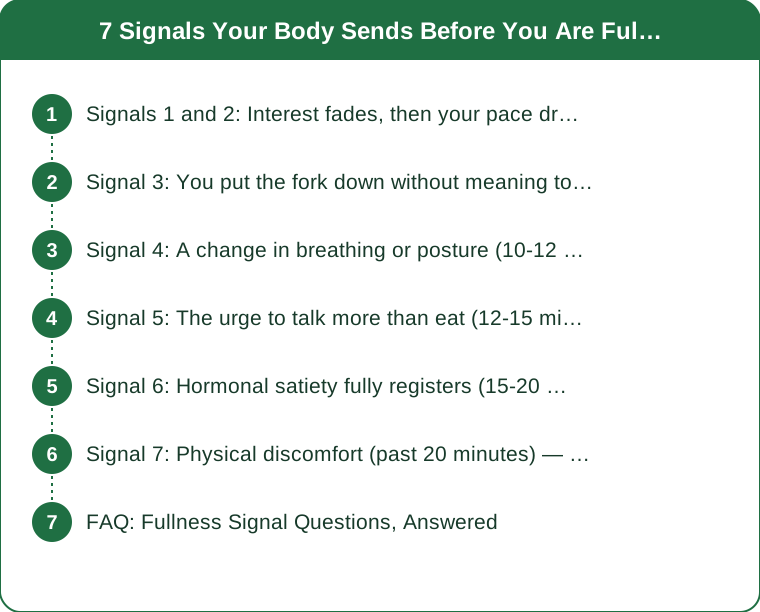
Signals 1 and 2: Interest fades, then your pace drops (the first 8 minutes)
The two earliest cues arrive close together, and almost nobody counts either one.
Signal 1: The food stops tasting as interesting (bite 5-10)
Sensory-specific satiety is measurable and fast. Researchers have documented that the pleasantness rating of a specific food drops significantly after just a few minutes of eating it, while the rating for other foods stays high. This is why dessert always has room.
The drop is real information. It signals that your body has registered enough of that particular food’s nutrient profile. It is not boredom and it is not a lack of discipline.
Most people override it by changing foods. A bite of the side dish, then back to the main, resets the perceived interest and extends the meal well past this signal.
How to catch it: rate the third bite and the tenth bite. When the tenth is noticeably less compelling than the third, signal one has arrived.
Signal 2: Chewing speed drops on its own (5-8 minutes in)
Eating rate declines naturally as satiety builds. Observational studies of meal duration find people slow down measurably in the second half of a meal without being aware of it.
Distraction erases this signal completely. Eating while scrolling or watching keeps pace constant, which is one of the clearest mechanisms behind distracted overeating — it is not that you eat faster, it is that you never slow down.
How to catch it: notice whether you are still eating at the same rhythm you started at. If the fork is moving as fast at minute eight as at minute one, something external is driving the pace.
Signal 3: You put the fork down without meaning to (7-10 minutes)
A small physical pause that arrives unprompted.
Spontaneous pauses correlate with rising satiety. People who are genuinely tracking fullness set utensils down between bites; people who are not tend to hold the fork continuously.
The pause is a decision point, not an interruption. This is the moment where checking in with yourself is most useful, because the signal is fresh.
How to catch it: set the fork down deliberately every five bites for the first half of the meal. This turns an unreliable spontaneous signal into a scheduled one, which is far easier to notice.
Signal 4: A change in breathing or posture (10-12 minutes)
The most physical of the early cues.
Stomach distension changes how you sit. As the stomach fills, people shift back in the chair and breathe slightly more shallowly. This is mechanical, not interpretive.
Tight clothing masks it. A waistband that was snug before the meal removes your ability to detect gradual distension — you feel constriction from the clothing rather than from the food.
How to catch it: take one full breath halfway through the meal. If it feels shorter than the breath you took before you started, the stomach has done more than you thought.

Signal 5: The urge to talk more than eat (12-15 minutes)
In company, this one is unmistakable once you know to look.
Attention shifts outward as satiety builds. Early in a meal, hunger narrows focus to the plate. As satiety rises, attention broadens to conversation and surroundings.
This is why eating alone is harder. With no conversation available, there is no outward attention shift to notice, and the plate stays the only object of focus.
How to catch it: eating alone, look up from the plate at minute twelve. If looking away feels easy, satiety is rising. If it feels like an effort, you are still genuinely hungry.
Signal 6: Hormonal satiety fully registers (15-20 minutes)
The signal everyone has heard about and almost nobody waits for.
Gut hormones take time. CCK, GLP-1, and PYY are released as food reaches the small intestine and require roughly 15 to 20 minutes to influence appetite centers in the brain. Leptin operates on a longer timescale still.
This is the basis of the twenty-minute rule, and the reason a meal eaten in eight minutes almost always ends in eating past fullness — the meal is over before the signal arrives.
Speed is the main variable you control. Extending a meal from 10 to 20 minutes with the same food consistently reduces total intake in controlled studies.
How to catch it: make the meal last 20 minutes by structure rather than willpower — smaller bites, water between courses, or simply serving less and going back if you still want more.
Signal 7: Physical discomfort (past 20 minutes) — and what to do instead
The last signal, the only one most people use, and the one that arrives too late to act on.
Discomfort means the earlier six were missed. By the time the stomach is uncomfortably stretched, you are 200 to 400 calories past the point where signals two through five appeared.
Using it as your stopping cue trains you to need it. Repeatedly ignoring early signals reduces sensitivity to them over time, which makes the problem self-reinforcing.
The practical intervention: serve less and allow seconds. Nothing else changes the outcome as reliably, because it inserts a decision point at minute twelve rather than minute twenty-five.
And eat the first five minutes without distraction, even if the rest of the meal is in front of a screen. Signals one through three all arrive in that window, and protecting only those five minutes catches most of what you are currently missing.
This is general information, not medical advice. If you experience persistent loss of fullness cues, eating that feels out of control, or significant distress around food, a qualified professional can help far more than any technique here.
FAQ: Fullness Signal Questions, Answered
Why can I eat dessert when I am too full for dinner?
Sensory-specific satiety. Your satiety for savory food is high while your satiety for sweet food is untouched, because the two register separately. This is a real physiological effect rather than a lack of discipline, and it is also why buffets and variety-heavy meals reliably increase intake.
Does drinking water before a meal actually help?
Modestly. Water creates stomach distension, which contributes to signal four, but it empties quickly and does not trigger the hormonal cascade that food does. Studies show a small reduction in intake — helpful, but much smaller than the effect of extending meal duration to 20 minutes.
How long does it take to get better at noticing these?
Most people report noticeable improvement within two to three weeks of consistently protecting the first five distraction-free minutes. The earlier signals do not get louder — you get better at hearing signals that were always there, which is why the practice works even though nothing about your body changes.
TL;DR:
- Fullness arrives as seven separate signals across roughly 20 minutes, not one moment.
- The earliest cue — food becoming less interesting — appears within 5 to 10 bites and is almost universally ignored.
- Hormonal satiety needs 15 to 20 minutes, so a fast meal ends before the signal arrives.
- Serving less with seconds allowed, and protecting the first five minutes from distraction, catch most of the missed cues. Pick signal one and watch for it at your next meal. Comparing bite three to bite ten takes no effort and it is the cue that gives you the most warning.
Keep Reading
This article is for general informational purposes only and is not medical advice. Always consult a qualified health professional for guidance specific to you.