7 Reasons Mindful Eating Stops Working After a Few Weeks
Quick Answer: Mindful eating fades because attention habituates. Once chewing slowly becomes routine, it stops requiring awareness, and awareness was the active ingredient. The fix is rotating the cue, not trying harder at the same one.
The first two weeks were genuinely different. You noticed flavors, you stopped at satisfied, meals felt like events. Week five, you are chewing slowly while scrolling and finishing the bowl anyway. Nothing broke. It just became a habit, and habits run without you.

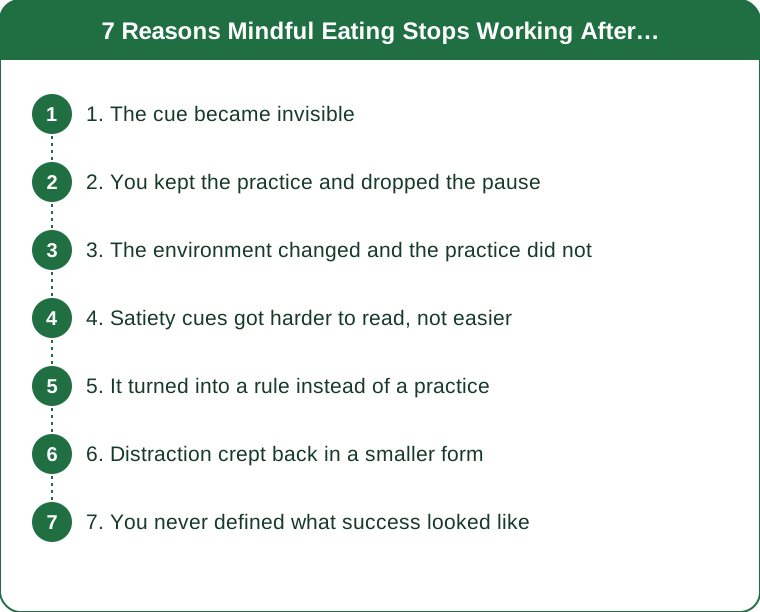
1. The cue became invisible
Every mindful eating instruction is a cue: put the fork down, chew twenty times, take three breaths first. Cues work because they interrupt an automatic sequence.
After roughly three weeks of repetition, the brain folds the cue into the sequence. Putting the fork down becomes part of eating rather than an interruption to it.
The practical fix is rotation. Change the cue every two to three weeks: fork down one block, non-dominant hand the next, eating with your eyes closed for the first three bites after that. Novelty is doing the work, not any specific technique.
2. You kept the practice and dropped the pause
Most programs teach a pre-meal pause: a few seconds to check actual hunger before the first bite. It is the highest-value part of the whole practice and the first thing to disappear.
Slow chewing without the pause is just slow autopilot. You still eat the amount you served, only more elegantly.
Rebuild it as a physical action rather than an intention. Sit down, put both hands in your lap, count three breaths, then pick up the fork. A body-based cue survives distraction far better than a mental one.
3. The environment changed and the practice did not
Mindful eating usually gets learned in ideal conditions: alone, quiet, unhurried. Then real life arrives with a work lunch, a toddler, and a 22-minute window.
A practice built for calm conditions does not transfer. It has to be rebuilt for the conditions you actually eat in.
Pick the one meal per day you can genuinely control and protect that one. One reliable mindful meal beats three aspirational ones, and the skill generalizes outward over months.

4. Satiety cues got harder to read, not easier
This surprises people. As portions shrink and eating slows, the difference between comfortable and slightly-full narrows, which makes the signal subtler rather than louder.
Early on you were catching the difference between stuffed and satisfied, which is a huge gap. Later you are trying to catch the difference between satisfied and pleasantly full, which is a small one.
Use an external anchor for a while. Mid-meal check at the halfway point: put the utensil down, rate fullness 1-10, and decide whether the second half is still wanted. Decisions beat sensations when sensations get quiet.
5. It turned into a rule instead of a practice
The moment chewing 20 times becomes a rule you can fail, the whole thing shifts from curiosity to compliance. Compliance produces rebellion, and rebellion produces the exact eating you were trying to change.
The tell is language. If you catch yourself saying you were “good” or “bad” at a meal, the practice has already turned into a diet in a soft sweater.
Switch the question. Not “did I do it right” but “what did I notice.” Noticing cannot be failed, which is exactly why it keeps working.
6. Distraction crept back in a smaller form
Nobody goes back to eating in front of a screen all at once. It returns as a podcast, then a quick email check, then the phone face-up on the table.
A face-up phone measurably reduces meal attention even when it stays untouched, because part of you is monitoring it.
Make it binary and physical: phone in another room, not face-down. Face-down is a negotiation. Another room is a decision, and decisions do not have to be re-made every meal.
7. You never defined what success looked like
Without a definition, the only feedback available is the scale, and the scale is a noisy, delayed, demoralizing signal for a practice about attention.
Define it in terms you can observe the same day: did I sit down, did I pause first, did I notice the halfway point, did I stop when I intended to.
Four yes-or-no questions, tracked for two weeks, will tell you more about whether the practice is alive than a month of weigh-ins.
Quick FAQ
Is mindful eating supposed to cause weight loss? Sometimes it does, indirectly, by reducing overeating. It is not a weight-loss method and treating it as one is the fastest way to lose the practice.
How slow is slow enough? Most research uses a 20-minute meal as the benchmark, because satiety signaling takes roughly that long to register.
What if I still finish everything? Then serve less and go back for more if you genuinely want it. Portion decisions made before the meal are easier than ones made mid-bite.
TL;DR:
- Attention habituates in about three weeks, so cues need rotating rather than repeating
- The pre-meal pause is the highest-value piece and the first to vanish
- Protect one controllable meal per day instead of aiming for all three
- Track observable actions, not the scale, or the practice turns into a diet
Pick one cue you have not used before and run it for the next two weeks at a single meal. The novelty is the mechanism, and rotating a cue takes less effort than rebuilding a practice you let go quiet.
Keep Reading
This article is for general informational purposes only and is not medical advice. Always consult a qualified health professional for guidance specific to you.