8 Reasons You Eat More on Weekends Than You Realize
Quick Answer: Weekend intake runs higher than weekday intake for most people by roughly 200 to 500 calories per day, driven by unstructured meal timing, social eating, alcohol, and the absence of the environmental cues that regulate weekday eating. The fix is not restriction — it is restoring two or three of the structures that weekdays provide automatically, particularly a consistent first meal and a defined eating window.
Nobody plans this. You are not making different decisions on Saturday, you are making the same decisions in an environment that has removed every guardrail. Here are the eight mechanisms, and what actually counters each one.

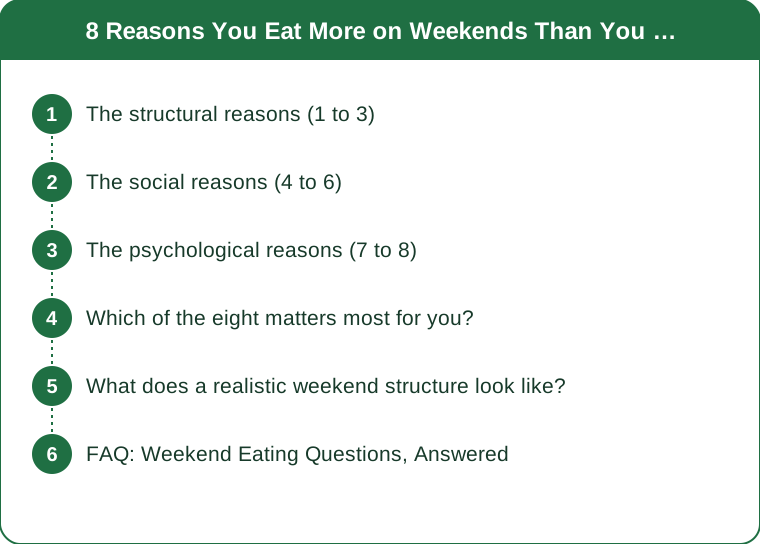
The structural reasons (1 to 3)
1. Your first meal moves, and everything downstream moves with it
Sleeping in two hours pushes breakfast to 10:30, which pushes lunch to 3, which means dinner arrives when you are genuinely ravenous. Late first meals compress the eating window and stack the largest portions into the evening, when self-regulation is at its weakest. Research on meal timing consistently finds calorie intake skews later on weekends by 90 minutes or more.
The counter: keep the first meal within an hour of your weekday time even if you sleep in. It does not have to be big — a yogurt and coffee is enough to anchor the sequence.
2. The environmental cues that regulate you disappear
On a weekday, meetings end lunch, the office closes, and the commute puts a wall between afternoon and evening eating. On Saturday, none of these exist. You are relying entirely on internal cues, and internal hunger signals are much less reliable than most of us assume.
The counter: build one artificial boundary. A scheduled activity at 2pm does more for weekend eating than any rule about what you can eat.
3. Food is physically closer
Weekday eating is bounded by what you packed or what is near the office. Weekend eating happens in a kitchen you own, where everything is 15 steps away and visible. Proximity and visibility are two of the most powerful drivers in eating behavior research — the same snack eaten from a counter versus a closed cupboard shows dramatically different consumption rates.
The counter: move the visible things. This is a 90-second intervention with a bigger effect than most week-long resolutions.
The social reasons (4 to 6)
4. You eat at the pace of the group
Eating with others increases intake substantially, and the effect scales with group size — a meal with four or more people can run 40 to 75 percent longer than a solo meal, and duration drives quantity. You match the pace of whoever is eating slowest and keep going.
The counter: pace to your own plate rather than the table. Put your fork down between bites when the conversation gets going. It feels absurd and it works.
5. Alcohol does two things at once
It adds calories directly — roughly 120 per glass of wine, 150 per beer — and it lowers the inhibition that would otherwise stop you at the second slice. The disinhibition effect is usually larger than the calories in the drink itself.
The counter: alternate with water and eat a real meal beforehand. Drinking on an empty stomach reliably produces the largest downstream intake.
6. Restaurant portions reset your sense of normal
A restaurant entree averages two to three times a home-cooked portion. Eat out twice on a weekend and your calibration for what a plate looks like shifts, which follows you into Monday.
The counter: decide the portion before it arrives — half the plate boxed at the start, or an appetizer plus a side rather than an entree. The decision made before the food lands is the one that holds.
The psychological reasons (7 to 8)
7. The weekend is framed as earned
Five days of effort creates an implicit ledger, and the weekend reads as the payout. This is licensing, and it is one of the most consistently demonstrated effects in eating behavior. The more restrictive the weekday, the larger the weekend swing — which is why very strict weekday plans produce worse weekly averages than moderate ones.
The counter: soften weekdays slightly. Adding something genuinely enjoyable to Tuesday reduces the pressure on Saturday more than any amount of weekend willpower.
8. You are not tracking, watching, or noticing
Awareness itself changes intake. People eat less when they are paying attention, independent of any rule. Weekends are when notes apps close, and the absence of observation is its own mechanism.
You do not have to log to notice. A ten-second mental review before each meal — am I hungry, what am I about to eat, is this what I want — captures most of the benefit without any of the friction.
The counter: pick one weekend meal to eat with full attention. Not all of them. One.

Which of the eight matters most for you?
They are not equally weighted, and the top one differs by person.
If your weekend starts with a long sleep-in, reason one is doing most of the damage and fixing it alone will change the whole day.
If you have consistent social plans — brunch, dinners out, gatherings — reasons four through six dominate, and the fix belongs in restaurant strategy rather than home behavior.
If your weekends are largely at home and unstructured, reasons two, three, and eight are the cluster to attack, and they are the easiest ones to solve because they are environmental rather than social.
A quick diagnostic: think back to last weekend and identify the single eating episode you would take back. Which of the eight explains it? That is your leverage point, and working on the other seven is mostly wasted effort.
One caution worth stating: a weekend that runs a few hundred calories higher is not a failure. Averaged across seven days it is a small effect, and treating it as a crisis is precisely what produces the restrict-and-swing cycle in reason seven.
What does a realistic weekend structure look like?
Three anchors, nothing more.
Anchor one: first meal within an hour of your weekday time. This is the highest-leverage change on the list. It does not require getting up early — just eating something shortly after you do get up.
Anchor two: one scheduled thing on each weekend afternoon. A walk, a class, an errand with a fixed time. It breaks the open-ended stretch where most unplanned eating happens.
Anchor three: decide the drinks and the eating-out portion before you leave the house. Not a rule, a decision. Made in advance, it holds; made at the table, it does not.
That is it. No tracking, no forbidden foods, no rules about what a weekend should look like. Three structures replacing the dozen that weekdays gave you for free.
Right now, with the last long-daylight weekends of the year, the afternoon anchor is easy — a walk at 5pm is genuinely pleasant. In six weeks it gets harder as the light goes, which is a good reason to build the habit while the weather is doing half the work.
FAQ: Weekend Eating Questions, Answered
Should I eat less on weekdays to compensate?
No. That is the restrict-and-swing loop, and it reliably makes weekends larger. Weekly averages come out better with consistent moderate intake across all seven days than with strict weekdays and unregulated weekends.
Is one big weekend meal actually a problem?
Generally not. A single large meal is absorbed into a weekly average without much consequence. The pattern that matters is continuous grazing across two full days, which is much harder to notice and adds up to far more.
Why do I feel hungrier on weekends despite moving less?
Usually disrupted timing rather than genuine increased need. A late first meal produces a stronger appetite response later in the day, and low-grade boredom is easily misread as hunger. Check the clock and the last time you ate before deciding it is hunger.
TL;DR:
- Weekend intake runs 200 to 500 calories higher for most people, driven by structure loss rather than different choices.
- The eight mechanisms are: shifted first meal, missing environmental cues, food proximity, social pacing, alcohol, restaurant portions, the earned-reward frame, and reduced awareness.
- Fixing the first meal timing alone resolves the largest share for most people.
- Three anchors are enough: early first meal, one scheduled afternoon activity, and drinks or portions decided in advance.
Pick the single mechanism that explains last weekend and work on that one. Trying to fix all eight is the same overcorrection that created the pattern in the first place.
Keep Reading
This article is for general informational purposes only and is not medical advice. Always consult a qualified health professional for guidance specific to you.