7 Small Changes That Make Mindful Eating Actually Stick Past Week One
Quick Answer: Mindful eating sticks when it’s built around small, specific environmental changes — like removing screens and using smaller serving tools — rather than relying purely on willpower or remembering to ‘eat slower,’ which fades within days for most people.
Everyone starts mindful eating with good intentions and a slower first bite. By day three, old habits creep back in. The difference between people who keep it up and people who don’t usually comes down to a handful of small, concrete changes rather than sheer willpower.

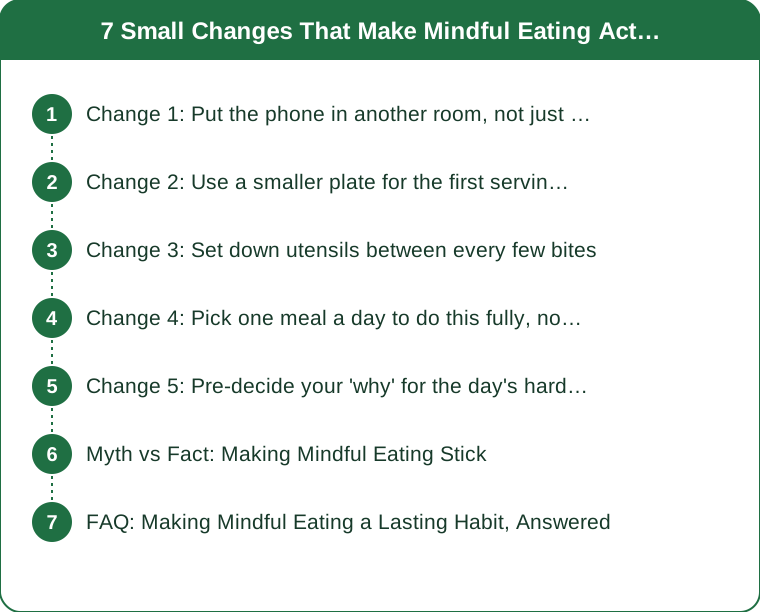
Change 1: Put the phone in another room, not just face-down
Face-down on the table still pulls attention every time it buzzes or lights up at the edge of vision. Moving it to another room entirely for the duration of a meal removes the temptation completely rather than testing willpower against it. This single change is consistently reported as the biggest lever for actually noticing fullness cues, since distracted eating is one of the most well-documented drivers of mindless overeating.
Change 2: Use a smaller plate for the first serving only
A smaller plate for the first serving (with seconds always available afterward) uses a well-documented perception effect — the same portion looks more substantial on a smaller plate, and finishing what looks like a full plate provides a satisfaction signal before deciding whether more food is actually wanted, rather than defaulting to a large plate that reads as ‘not enough’ even when it’s a full portion.
Change 3: Set down utensils between every few bites
Physically placing the fork or spoon down after each bite, rather than holding it through chewing, naturally slows pacing without requiring conscious effort to ‘eat slower.’ This one small mechanical habit does more to extend meal duration than actively trying to remember to slow down, since it removes the option to shovel the next bite in before finishing the last one.

Change 4: Pick one meal a day to do this fully, not all three
Trying to mindfully eat every single meal from day one is a common reason the habit collapses fast — it’s simply a lot of sustained attention to maintain three times a day. Picking one meal, often dinner since it’s usually less rushed than breakfast or lunch, to practice fully gives the habit room to become automatic before expanding it further.
Change 5: Pre-decide your ‘why’ for the day’s hardest meal
The meal most likely to derail mindful eating (often a stressful lunch, or dinner after a long day) benefits from a quick, pre-decided intention — even a single sentence like ‘I’m eating dinner to actually enjoy it tonight’ — set before sitting down. This tiny bit of pre-commitment measurably reduces the odds of falling back into autopilot eating during the exact meal most likely to trigger it.
Myth vs Fact: Making Mindful Eating Stick
Myth: Mindful eating requires eating in total silence with no distractions of any kind. Fact: The core requirement is reduced distraction and attention to actual hunger and fullness signals — a conversation at the table is compatible with mindful eating; a phone scroll generally isn’t.
Myth: If you slip up one meal, the whole practice is broken. Fact: Mindful eating is a skill built meal by meal — one distracted meal doesn’t undo the pattern building from the others, and treating a slip as a full reset is often what causes people to quit entirely.
FAQ: Making Mindful Eating a Lasting Habit, Answered
How long does it typically take before mindful eating feels automatic rather than effortful?
Most people report it starting to feel more natural after 3-4 weeks of consistent practice on at least one meal a day, though this varies individually and tends to accelerate once the environmental changes (like the phone-in-another-room habit) are fully in place.
Does eating mindfully mean eating less?
Not necessarily — the goal is better attunement to actual hunger and fullness, which sometimes means eating less than habit would have dictated, but sometimes means eating more than a restrictive mindset would have allowed; it’s about accuracy, not restriction.
What’s the most common reason people abandon mindful eating within the first week?
Trying to apply it to every meal immediately, rather than starting with one meal a day, is the most commonly cited reason it collapses fast — the sustained attention required across three meals daily from day one is a lot to maintain before the habit has had time to become easier.
TL;DR:
- Phone in another room (not just face-down) removes the biggest distraction entirely
- Smaller first-serving plate uses portion perception to signal satisfaction sooner
- Setting utensils down between bites slows pacing without conscious effort
- Start with one meal a day, not all three, and expect it to feel automatic in 3-4 weeks
The third change surprises a lot of people — it sounds trivial, but putting the fork down between bites does more for pacing than any amount of willpower.
Keep Reading
This article is for general informational purposes only and is not medical advice. Always consult a qualified health professional for guidance specific to you.