7 Signs You're Eating Out of Habit, Not Actual Hunger
Quick Answer: The clearest sign of habit eating is that it happens at the same time or trigger every day regardless of your last meal — genuine hunger builds gradually and varies day to day, while habit eating feels sudden, specific, and tied to a cue like a location, time, or activity.

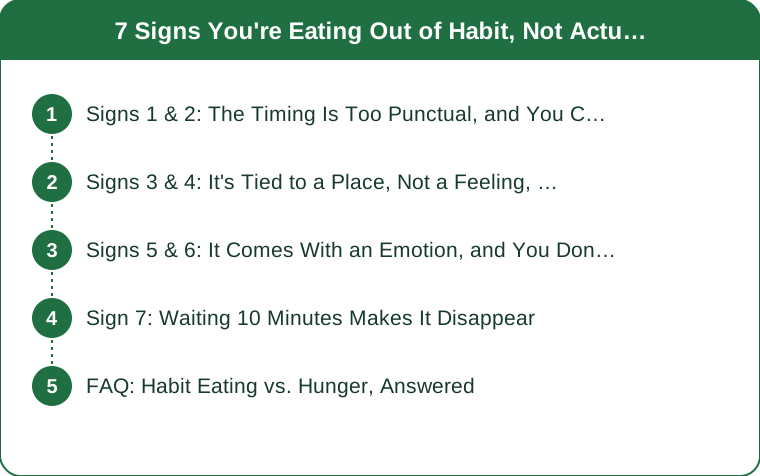
Signs 1 & 2: The Timing Is Too Punctual, and You Can’t Name What You Want
Sign 1: It Happens at the Exact Same Time Every Day
Real hunger fluctuates based on your last meal’s size and timing, your activity level, and sleep — it doesn’t arrive at precisely 3pm every single day regardless of what you ate for lunch. If your ‘hunger’ is remarkably punctual, it’s more likely a learned routine than a physical signal.
Sign 2: You Can’t Say Which Food You Actually Want
Genuine hunger usually comes with some sense of what would satisfy it, even if broad. Habit eating tends to be non-specific — you’re not craving anything in particular, you just want to be eating something, which points to boredom, stress relief, or routine rather than a nutritional need.
Signs 3 & 4: It’s Tied to a Place, Not a Feeling, and a Full Meal Doesn’t Stop It
Sign 3: It’s Tied to a Location or Activity, Not a Feeling
Notice if the urge shows up specifically when you sit at your desk, turn on the TV, or walk past the kitchen — these are environmental triggers, not internal hunger signals. Physical hunger doesn’t care what room you’re in.
Sign 4: A Full Meal an Hour Ago Doesn’t Stop It
If you genuinely ate a substantial meal recently and still feel a pull to eat again soon after, your body is very unlikely to be physically hungry again already — digestion and satiety signals typically last 3-4 hours minimum after a real meal.

Signs 5 & 6: It Comes With an Emotion, and You Don’t Remember Starting
Sign 5: It Comes With a Specific Emotion
Stress, boredom, anxiety, or even happiness can all trigger a reach for food that has nothing to do with your stomach. If you can name a feeling attached to the urge that isn’t ‘stomach feels empty,’ that’s a strong clue it’s emotional or habitual rather than physical.
Sign 6: You Don’t Remember Deciding to Eat
Habitual eating often happens almost automatically — you’re mid-scroll or mid-show and realize the bag of chips is half empty without a clear memory of choosing to start. Genuine hunger usually involves at least a brief, conscious decision point.
Sign 7: Waiting 10 Minutes Makes It Disappear
This is the most reliable test of all seven: physical hunger doesn’t vanish if you distract yourself for ten minutes, while habit-driven urges frequently do. If the craving evaporates once you’re absorbed in something else, it likely wasn’t hunger to begin with.
FAQ: Habit Eating vs. Hunger, Answered
Is it bad to eat out of habit sometimes?
No, occasional habit eating isn’t harmful — the goal is awareness, not elimination, since some habitual eating (like a planned afternoon snack) is perfectly fine if it fits your overall pattern.
What should you do in the moment if you realize it’s habit, not hunger?
Try a brief pause — a glass of water, a short walk, or simply naming the trigger out loud — before deciding whether to eat, which interrupts the automatic pattern without requiring willpower alone.
Does this mean you should never eat unless you’re truly hungry?
Not necessarily — eating for pleasure or social reasons occasionally is normal and healthy; the goal is recognizing the pattern so it’s a choice rather than an unconscious default.
TL;DR:
- Real hunger builds gradually and varies; habit eating is punctual and predictable
- Non-specific cravings and location-triggered urges point to habit, not hunger
- A recent full meal makes true hunger unlikely within an hour or two
- The 10-minute distraction test is the most reliable way to tell the difference
None of these signs mean habit eating is wrong — they just help you notice when you’re on autopilot so eating becomes a choice again instead of a reflex.
Keep Reading
This article is for general informational purposes only and is not medical advice. Always consult a qualified health professional for guidance specific to you.