7 Signs You're Eating Out of Habit, Not Actual Hunger
Quick Answer: Habit eating tends to happen at a predictable time or trigger regardless of your last meal, comes on suddenly rather than gradually, and often targets a specific craved food rather than being satisfied by any food — genuine hunger typically builds gradually and is satisfied by a range of options.
The hand reaches for the snack before the brain has actually asked whether you’re hungry. These seven signs catch that gap before the bite happens on autopilot.

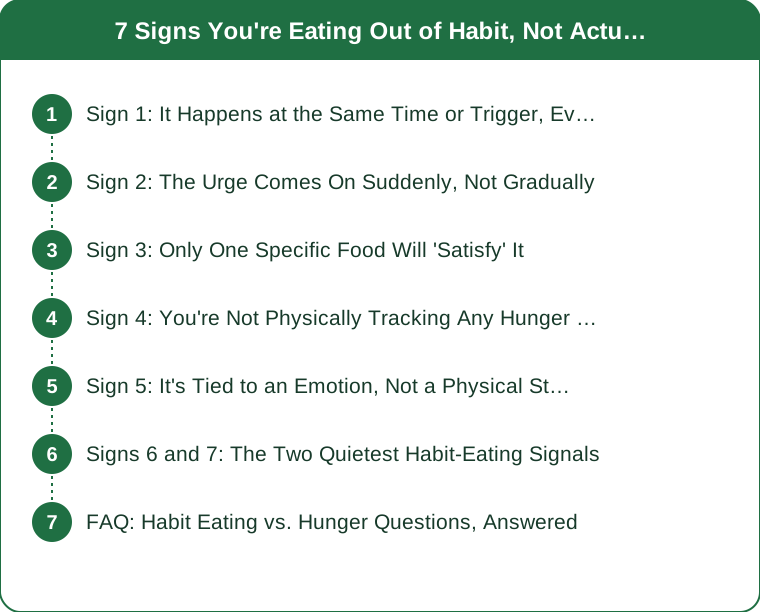
Sign 1: It Happens at the Same Time or Trigger, Every Single Day
Eating that consistently lines up with a specific time, location, or activity — 3pm at your desk, right after a stressful call — regardless of your last meal, points toward habit rather than a genuine physiological hunger signal, which varies more based on what and when you last ate.
Sign 2: The Urge Comes On Suddenly, Not Gradually
True physical hunger tends to build gradually over an hour or more, while habit-driven eating urges often appear abruptly, triggered by an external cue (seeing food, a specific location, a stress trigger) rather than a slow internal signal.
Sign 3: Only One Specific Food Will ‘Satisfy’ It
Genuine hunger is generally satisfied by a range of reasonably appealing food options, while a craving that only one very specific food can resolve — a particular snack, a specific drink — often points to a habitual or emotional trigger rather than actual caloric need.

Sign 4: You’re Not Physically Tracking Any Hunger Cues
An absence of typical physical hunger signals — stomach emptiness, slight energy dip, difficulty concentrating — while still feeling a strong urge to eat is one of the more reliable habit-versus-hunger distinctions, since true hunger usually comes with at least one physical marker.
Sign 5: It’s Tied to an Emotion, Not a Physical State
Eating that follows boredom, stress, or anxiety, rather than physical depletion, is a well-documented pattern distinct from hunger-driven eating — the eating serves an emotional regulation function rather than a nutritional one.
Signs 6 and 7: The Two Quietest Habit-Eating Signals
Sign 6: You Don’t Remember Deciding to Eat
Mindless, habit-driven eating often happens with minimal conscious decision-making — reaching for a snack while working or watching TV without a clear moment of choosing to eat is a strong habit signal.
Sign 7: You Still Feel Unsatisfied After Eating
True hunger resolves with eating; habit or emotional eating frequently leaves a lingering sense of dissatisfaction even after finishing the food, since the underlying trigger (boredom, stress, habit) wasn’t actually addressed by eating.
FAQ: Habit Eating vs. Hunger Questions, Answered
Is habit eating always something to fix?
Not necessarily — some habitual eating patterns (a consistent afternoon snack) are perfectly fine if they fit your overall goals; the value of noticing the distinction is having the choice, not eliminating all habit eating.
What’s a quick way to check which one is happening?
Pausing for 60-90 seconds before eating and asking whether a plain, simple food (like an apple) would also satisfy the urge is a fast, practical check.
Does this distinction matter for weight management specifically?
It can — recognizing habit-driven eating gives you the option to address the actual trigger (boredom, stress) directly, which some find more effective than restricting food itself.
TL;DR:
- Habit eating tends to hit suddenly and at predictable triggers, unlike gradually building true hunger
- Cravings for one very specific food often signal habit or emotion, not physical need
- Absent physical hunger cues alongside a strong urge to eat is a reliable habit indicator
- Lingering dissatisfaction after eating suggests the real trigger wasn’t food-related at all
Noticing which of the seven signs is happening doesn’t mean never eating out of habit again — it just means eating on purpose instead of on autopilot.
Keep Reading
This article is for general informational purposes only and is not medical advice. Always consult a qualified health professional for guidance specific to you.