7 Signals Your Body Sends Before You Eat Past Actually Full
Quick Answer: The body sends several distinct fullness signals well before the final ‘stuffed’ feeling — a slight slowing in eating pace, reduced taste intensity, and a subtle mental shift from craving to simply continuing are among the earliest, and catching them requires actively checking in partway through a meal rather than eating on autopilot until the stomach itself signals stop.
Most people only notice one fullness signal: the uncomfortable ‘I ate too much’ feeling at the very end. By then, six earlier, subtler signals already passed by unnoticed. Here they all are, in the order they typically show up.

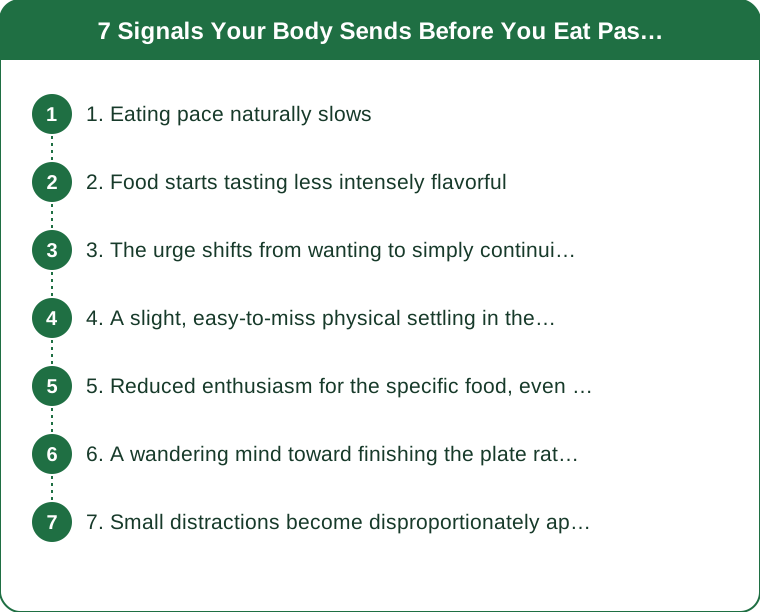
1. Eating pace naturally slows
Early in a meal, most people eat at a fairly consistent pace. Somewhere around the halfway-to-satisfied point, pace naturally slows a little — smaller bites, more pauses — even before consciously feeling full. This is one of the earliest physical signals and the easiest to miss if eating quickly or distractedly.
2. Food starts tasting less intensely flavorful
The first few bites of a meal typically taste the most vivid; this is a well-documented sensory-specific satiety effect. A noticeable dulling of flavor intensity partway through is an early signal worth noticing, not just a sign the food itself changed.
3. The urge shifts from wanting to simply continuing out of habit
There’s a distinct mental shift from genuinely wanting the next bite to simply continuing because food is still on the plate. This shift is subtle and easy to miss when eating on autopilot, but it’s one of the more reliable early signals that hunger has already been addressed.

4. A slight, easy-to-miss physical settling in the stomach
Before the more obvious ‘full’ sensation, there’s an earlier, gentler settling — a sense of the stomach beginning to fill rather than being actively empty — that’s genuinely easy to miss if eating fast or distracted by a screen.
5. Reduced enthusiasm for the specific food, even if it’s still ‘good’
The food can still objectively taste good while your enthusiasm for continuing to eat it clearly drops — this is a distinct signal from taste dulling (signal 2) and often shows up slightly later, closer to actual satisfaction.
6. A wandering mind toward finishing the plate rather than the food itself
Attention shifting toward ‘finishing what’s there’ rather than the experience of eating is a signal that habit (plate-clearing, or a mental commitment to a portion) has taken over from actual hunger as the driver of continued eating.
7. Small distractions become disproportionately appealing
A phone notification, a conversation, or a task suddenly becoming more interesting than the food itself often signals satisfaction has been reached — the meal has stopped competing successfully for attention, which is a subtler cue than any physical sensation.
TL;DR:
- Fullness signals arrive in a sequence, well before the final stuffed feeling most people wait for
- Slowed eating pace and reduced taste intensity are among the earliest, most missable cues
- A shift from wanting to simply continuing is a mental signal worth checking in on mid-meal
- Checking in around the halfway point of a meal catches most of these before overeating happens
FAQ: Early Fullness Signals, Answered
How often should you check in during a meal for these signals?
A single deliberate pause around the halfway point of a meal is usually enough to catch most of these signals before they’re missed entirely.
Does eating slower actually help notice these signals better?
Yes, meaningfully — most of these signals require a moment of attention to register, and eating quickly compresses the window where they’re noticeable at all.
Is it normal to miss all seven signals regularly?
Very common, especially when eating while distracted — noticing even two or three consistently is a meaningful improvement over noticing none.
Keep Reading
This article is for general informational purposes only and is not medical advice. Always consult a qualified health professional for guidance specific to you.