7 Reasons You Finish a Meal and Cannot Remember Tasting It
Quick Answer: You cannot remember tasting a meal because attention, not the mouth, is what encodes eating into memory. When attention is elsewhere, the sensory experience never gets stored, and meal memory turns out to matter: people with poorer recall of a recent meal eat measurably more at the next one. The seven most common causes are screen distraction, eating while standing, speed, conversation load, arriving too hungry, repetition of the same meal, and eating in a space your brain has coded as a work environment. Each has a distinct and small fix.
You sit down with a plate. At some point later the plate is empty. There is no moment in between that you can actually recall.
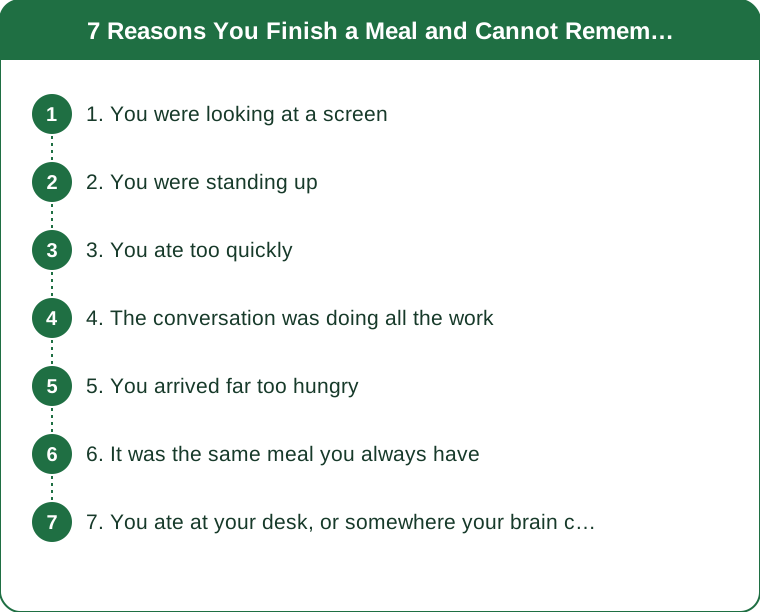
It feels like a small thing, and it is measurable, and it has downstream effects on how hungry you are two hours later. Here are the seven reasons it happens, in rough order of how often each is the culprit.

1. You were looking at a screen
The most common cause by a wide margin, and the best studied.
What the research shows. Multiple controlled experiments have found that people eating while distracted, typically by television or a computer task, consume more during the meal and substantially more at a later meal on the same day. The later-meal effect is the striking one, since it indicates the mechanism is memory rather than simple overconsumption in the moment.
Why it works this way. Attention is required to encode an experience into episodic memory. Without encoding there is no retrieval cue later, and your brain uses recall of recent eating as one input into hunger.
The fix, which is smaller than the advice usually given: you do not need to eat in silence. Put the screen out of your line of sight for the first five minutes. Most of the encoding that matters happens early in the meal, and the first few bites carry disproportionate weight.
A test worth trying once: eat the first five minutes with the phone face down, then use it if you want. Compare your hunger at 4pm against a day where you scrolled throughout.
2. You were standing up
Standing is an underrated variable, and it changes both speed and attention.
Why it matters. Eating while standing at the counter is almost always eating in transit, and the posture signals to your brain that this is not a meal. There is no beginning and no end, only a gradual grazing that produces no distinct memory.
Speed comes with it. Standing meals are consistently faster than seated meals, and speed is its own factor, covered below.
The specific pattern to watch for: standing at the fridge, at the counter while cooking, and over the sink. Many people eat 300 to 500 calories a day this way without any of it registering as eating.
The fix: sit down, even for two minutes, even for a snack. Putting food on a plate and sitting is the single most reliable intervention in this whole list, because it creates a start and an end.
Why the plate matters as much as the chair. Eating from a package has no visual endpoint. Eating from a plate does, and the visual evidence of what you consumed is part of what you recall later.
3. You ate too quickly
Speed compresses the experience below the threshold where it registers.
The mechanism. Satiety signalling involves gut hormones that take roughly 15 to 20 minutes to reach levels your brain responds to. Faster than that and you finish before the signal arrives, which is well known. The less-discussed part is that fast eating also produces fewer distinct sensory moments to remember.
Reference figures: a typical unhurried meal takes 20 to 30 minutes. Many people eat lunch in under 10. Chewing counts vary enormously by food and by person, and the useful instruction is not a number of chews, it is putting the utensil down between bites.
Why put the fork down works when chew-counting does not. Counting chews requires sustained attention, which is exactly the resource in short supply. Putting the fork down is a single physical action that automatically slows the whole meal without ongoing effort.
A realistic target: add five minutes. Going from an eight-minute lunch to a thirteen-minute lunch produces a noticeable difference in recall, and it is achievable in a working day in a way that a thirty-minute lunch may not be.

4. The conversation was doing all the work
Social eating is good for you and it competes for the same attention.
What happens. Engaged conversation, particularly one requiring effort like a work lunch or a difficult family discussion, occupies the attention that would otherwise encode the meal. This is why business lunches are so consistently unmemorable as food.
Social facilitation is also real. People eat more in company, and the effect scales with group size. Larger groups produce longer meals and larger intakes.
The distinction worth drawing: relaxed conversation with familiar people is compatible with noticing your food. Effortful conversation is not. If you leave a meal remembering the discussion in detail and the food not at all, the attention went somewhere valuable, and it is still worth knowing that your hunger later will behave as though you did not eat.
The fix, which is not to stop talking: notice the first three bites deliberately before the conversation gets going. This is the same five-minute principle in a different setting.
One thing to avoid: using conversation load as a reason to skip social meals. Eating with other people has well-documented benefits that outweigh the recall issue.
5. You arrived far too hungry
Extreme hunger changes how you eat in ways that make the meal impossible to remember.
What happens physiologically. Arriving at a meal after a long gap raises drive to eat, increases eating speed, and shifts attention narrowly onto consumption. The experience becomes functional rather than sensory.
The threshold most people describe is around five to six hours without food, and it is longer for some people and shorter for others. What matters is knowing your own.
Why this compounds with everything else. A very hungry person eating standing up while looking at a screen is stacking four of these seven factors at once, which is why the classic 6pm kitchen-counter grazing session is so completely unmemorable.
The fix: a small protein-containing snack in the gap, or moving the meal earlier. Neither is complicated and both require noticing the pattern first.
A caution against the opposite error. Constant grazing to prevent hunger produces its own version of this problem, where nothing is a meal and therefore nothing registers. Distinct eating occasions, with beginnings and endings, are the point.
6. It was the same meal you always have
Novelty is one of the strongest determinants of what gets encoded.
Why repetition erases memory. Your brain stores what is new. A meal identical to yesterday’s produces almost nothing distinctive to encode, so it merges into a general sense of having eaten that lunch many times rather than a memory of having eaten it today.
The practical consequence. People who eat identical meals daily for convenience frequently report exactly this: they know they ate and cannot recall it, and they are hungry sooner than the calories suggest.
The fix is smaller than changing your whole routine. Change one element. A different herb, a different sauce, a different vegetable, or even a different plate. One novel element gives the memory something to attach to.
Why this does not contradict meal prep. Batch-cooked components with varying finishing touches preserve convenience and restore novelty. The base can be identical if the top is not.
A related observation: the first bite of any dish is the most intensely tasted, and each subsequent bite is less so, a phenomenon called sensory-specific satiety. Varying components within a meal keeps this from flattening out.
7. You ate at your desk, or somewhere your brain calls work
Context conditions attention, and a work surface conditions work attention.
What is happening. Environments carry learned associations. Eating at a desk where you have spent hundreds of hours concentrating on other things puts you in a cognitive mode that is oriented outward, toward tasks, rather than inward toward sensation.
Why moving matters more than the food. People who move to a different room, a break area, or outdoors report clearer recall of the same food. The variable is not the meal, it is the context.
The minimum viable version: if you cannot leave your desk, clear it, turn away from the monitor, and face a different direction for the first five minutes. The physical reorientation does a surprising amount of work.
FAQ: Meal Memory Questions, Answered
Does forgetting a meal actually make me eat more later?
Yes, in controlled studies. Participants who ate while distracted, and who recalled the meal less well, consumed measurably more at a subsequent meal the same day. Memory of eating is one input into later appetite.
Do I have to eat in silence to eat mindfully?
No. The first three to five minutes carry most of the encoding value. Attending to the beginning of a meal and relaxing afterward captures most of the benefit without turning every meal into an exercise.
Why is it worse with meals I eat every day?
Novelty drives encoding. An identical meal produces little distinctive to remember, so it merges into a general impression rather than a specific memory. Changing one component restores most of the effect.
Seasonal note: as evenings get darker and shorter, meals move indoors and screens become more central to the evening routine, so the distraction factor rises measurably for most people between now and midwinter. Establishing the first-five-minutes habit before that shift is easier than reversing it in December.
TL;DR:
- Attention encodes meals into memory, and poor meal memory is associated with eating more at the next meal.
- Screens, standing, and speed are the three biggest causes, and each has a small physical fix.
- The first three to five minutes matter most. You do not need to eat the whole meal in focused silence.
- Repetition and eating at your work desk both suppress encoding independently of distraction.
Pick the one that describes you most and change it for a week. Most people find the 4pm hunger shifts noticeably.
Keep Reading
This article is for general informational purposes only and is not medical advice. Always consult a qualified health professional for guidance specific to you.