7 Reasons You Feel Hungrier on Days You Barely Move - and What Each One Needs
Quick Answer: Sitting all day disrupts appetite regulation more than it lowers energy needs. Moderate exercise briefly suppresses the hunger hormone ghrelin and improves insulin sensitivity - so on a sedentary day you lose both effects while gaining boredom cues, unbroken food access, and blood sugar that swings harder. The hunger is real signaling, not weakness. Each of the seven drivers below has a different fix.
The useful reframe: your appetite is responding to the day’s structure, not to the day’s calorie needs.
Which means the answer is structural too.

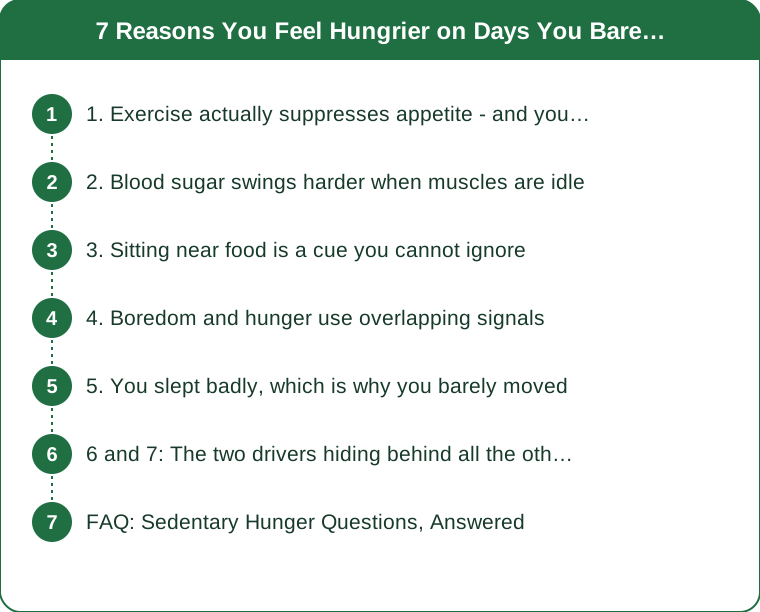
1. Exercise actually suppresses appetite - and you lost that
Moderate-to-vigorous exercise transiently suppresses ghrelin, the hormone that drives hunger, and increases satiety-signaling hormones like peptide YY. The effect is real and reasonably well documented, particularly after higher-intensity efforts.
On a training day you get that suppression for roughly one to two hours afterward, and it takes the edge off the whole afternoon. On a sedentary day it simply never happens.
This is why the day you ran six miles you genuinely forgot lunch, and the day you sat through four meetings you were rummaging in the cupboard at three.
What it needs: a short bout of real movement - 10-15 minutes brisk, enough to get breathing hard. Not for the calorie burn, which is trivial, but for the hormonal shift. Placed just before the time you usually crash, it does more than any snack swap.
2. Blood sugar swings harder when muscles are idle
Contracting muscle pulls glucose out of the bloodstream without needing insulin. When you sit, that pathway is largely offline, so the same lunch produces a higher glucose peak and a steeper drop afterward.
That drop is what you feel at 3 p.m. as urgent hunger - the physical sensation is real even when your body has plenty of available energy.
What it needs: two things that both work.
- A 5-10 minute walk within 20 minutes of eating. Research on post-meal walking shows meaningful blunting of the glucose spike from very short bouts.
- Restructure the meal: protein and fiber first, refined carbohydrate last. The order of eating within a meal measurably changes the glucose curve - vegetables and protein before starch is a genuinely free intervention.
3. Sitting near food is a cue you cannot ignore
Appetite responds to environment far more than most people credit. Seeing food, smelling it, walking past it, or simply knowing it is twelve steps away all generate real anticipatory responses - saliva, gastric activity, and yes, genuine hunger sensation.
On a sedentary work-from-home day you pass the kitchen dozens of times. On a gym-and-office day you might pass it twice.
This is the most fixable driver on the list and the one people are hardest on themselves about, as though noticing food were a character flaw.
What it needs: distance and friction. Work in a room without visible food. Keep snacks in an opaque container on a high shelf rather than in a bowl on the counter. Decide the afternoon snack in the morning and put it on a plate, which converts an open-ended cue into a closed decision.

4. Boredom and hunger use overlapping signals
Low-stimulation work generates a search for stimulation, and eating is the most available source in the room. This is not the same as emotional eating - it is closer to fidgeting.
The telltale sign: the craving is specific to texture rather than to food. You want crunch, or chew, not nutrition. Genuine hunger is fairly indifferent about texture.
What it needs: substitute the stimulation, not the food. Cold water, a walk outside, five minutes of a different task, gum, or genuinely - a phone call. If a five-minute change of activity makes the urge disappear, it was not hunger.
That five-minute test is the single most useful tool on this list, and it costs nothing to run.
5. You slept badly, which is why you barely moved
This one is a loop rather than a cause. Short sleep raises ghrelin and lowers leptin, which means a poor night produces a genuinely hungrier day - with a documented pull toward high-carbohydrate, high-fat food specifically.
And a poor night is also the most common reason a planned workout does not happen. So the sedentary day and the hungry day share a cause, and blaming the sedentary part misdiagnoses it.
What it needs: treat the appetite as information about sleep debt rather than a discipline problem. Eat adequate protein at breakfast, get outside in morning daylight, and protect that night’s sleep rather than trying to out-willpower the day.
On less than six hours, expect to be hungrier and plan for it instead of being surprised by it at 4 p.m.
6 and 7: The two drivers hiding behind all the others
6. Your meals were smaller than you think
There is a quiet pattern where sedentary days come with skipped or reduced meals - a rushed breakfast, a working lunch eaten in six minutes, no real dinner planning.
Under-eating early reliably produces over-eating late. The evening hunger is not a failure of restraint; it is accurate accounting arriving several hours after the deficit.
What it needs: front-load. Aim for 25-30 g of protein at breakfast and a lunch that includes protein, fiber, and some fat. People consistently report that the 4 p.m. urgency largely dissolves when breakfast protein goes up - it is the highest-return change in this whole article.
And eat lunch away from the screen for ten minutes. Meals eaten while working register as less satisfying even at identical calories, which is a well-documented distraction effect.
7. Stress hormones are running without a physical outlet
A demanding day generates the same stress response whether or not you move. Cortisol is associated with increased appetite, particularly for energy-dense food, and exercise is one of the more effective ways of discharging that response.
A sedentary high-stress day gives you the appetite signal with none of the discharge. That is a specific, physiological version of stress eating that has little to do with emotion.
What it needs: a physical outlet, even a small one. Stairs, a brisk lap of the block, ten minutes of anything that raises your heart rate. Breathing exercises work too and are available in a meeting - a few minutes of slow exhale-focused breathing measurably shifts the stress response.
The pattern to watch for: appetite that arrives right after a hard call or a difficult email rather than on a schedule.
FAQ: Sedentary Hunger Questions, Answered
Should I just eat less on days I do not exercise?
Generally no. A typical workout burns less than most people assume, so the actual energy difference between a training day and a rest day is smaller than the appetite difference suggests. Deliberately under-eating on rest days tends to produce a bigger evening rebound.
Is it bad to snack in the afternoon?
Not at all. A planned snack with protein and fiber is a useful tool. The problem is unplanned grazing, which is a cue-and-boredom pattern rather than a nutritional one.
Which of the seven should I tackle first?
Breakfast protein and a ten-minute post-lunch walk. Those two address drivers 1, 2, and 6 simultaneously, and neither requires any willpower after the first week.
TL;DR:
- Exercise suppresses ghrelin; sedentary days lose that suppression - the hunger is real signaling.
- Idle muscles mean sharper glucose swings. A 5-10 minute walk after eating blunts them.
- Environment and boredom are the biggest hidden drivers. Run the five-minute test before eating.
- Poor sleep causes both the hunger and the missed workout - treat it as sleep debt, not weakness.
- Start with 25-30 g of protein at breakfast and a post-lunch walk. Those two cover most of the list.
None of this is a discipline story. It is a structure story - and structure is considerably easier to change than willpower.
Keep Reading
This article is for general informational purposes only and is not medical advice. Always consult a qualified health professional for guidance specific to you.