7 Reasons You Eat More When You Are Eating With Other People
Quick Answer: Research on social facilitation of eating consistently finds that people eat more in company than alone - often 30 to 40 percent more with a group of several people, and up to 70 percent more in some group settings. The drivers are meal duration, attentional load, social matching, portion norms, and disinhibition. None of them require you to feel out of control, which is why the effect is so easy to miss.
The company is not the problem. Knowing which of the seven is operating on you is the fix.

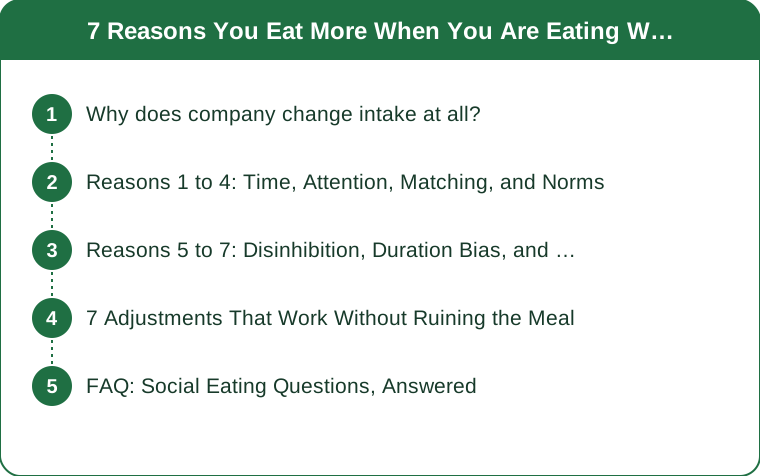
Why does company change intake at all?
Because eating is a social behaviour that our physiology never separated from a signal about safety and abundance, and because almost every mechanism regulating meal size is easier to override when your attention is elsewhere.
Social facilitation of eating is one of the more replicated findings in eating behaviour research. The pattern is dose-dependent - intake rises with group size, with the largest increases at tables of four or more. Meals eaten with one other person show a smaller but still measurable increase over eating alone.
The effect is not universal. It reverses in some contexts - people frequently eat less in the company of strangers, or when they believe they are being evaluated, which is called impression management. The increase shows up most reliably among people who are comfortable with each other: family, close friends, long-standing colleagues.
What follows is the seven mechanisms, roughly in order of how much they contribute. Most social meals involve three or four of them at once, which is why the combined effect is as large as it is.
Reasons 1 to 4: Time, Attention, Matching, and Norms
1. The meal simply lasts longer
This is the single largest contributor and the least psychological. Meals with company run substantially longer than solo meals - often double, sometimes more with a large group. Fullness signalling from the gut to the brain takes roughly 20 minutes to register meaningfully, but that only limits intake if you would otherwise have stopped. In a longer meal, the additional time is filled with continued eating: more bread, another serving, the shared dessert that only appeared because people were still sitting there. Longer meal, more opportunities, more intake.
2. Your attention is on the conversation
Eating while cognitively occupied reliably increases intake and, more interestingly, reduces memory of what was eaten - which then increases intake at the next meal. Conversation is a demanding attentional task. You are tracking what someone is saying, formulating responses, reading the room. The internal signals telling you that you have had enough are competing for attention with all of that, and they lose. This is the same mechanism as eating in front of a screen, wearing better clothes.
3. You unconsciously match the people around you
Behavioural matching, or modelling, is well documented and remarkably strong. People adjust their intake toward that of their companions, both in quantity and in pace, without any awareness of doing it. If you are eating with someone who eats quickly and eats a lot, your intake moves toward theirs. The effect is strongest with people you like or identify with, which means it is strongest exactly where you eat most often. Matching also works downward - which is why eating with a slower eater is one of the more effective and least effortful interventions available.
4. The portion norm is set by the table, not by you
We use external cues to decide what a normal amount is, and in company the reference point becomes the table. If everyone has a starter, having one becomes the norm. If bowls are shared, the serving-size decision moves from a plated portion to an open-ended one. Serving from shared dishes reliably increases intake compared to the same food plated individually, because there is no defined endpoint - each additional spoonful is a small decision rather than one large one.

Reasons 5 to 7: Disinhibition, Duration Bias, and the Occasion Frame
5. Social settings disinhibit restraint
People who are consciously restricting intake show the largest increases in company, and the effect is amplified by alcohol. Alcohol does two things at once - it directly stimulates appetite, and it reduces the cognitive control that restraint depends on. It also adds a substantial number of calories that are not registered as food at all. A social meal with two drinks is a different metabolic event from the same meal without them, and the difference is much bigger than the drinks themselves.
6. You misjudge time and pace
Engaging conversation produces a genuine distortion of time perception - a 90 minute meal feels like 45. Because people partly regulate eating by elapsed time and by how much others have eaten, that distortion means you feel earlier in the meal than you actually are. Pace also rises: matching a faster eater means more bites per minute, and fast eating is independently associated with higher intake, because it outruns the satiety signal entirely.
7. The occasion reframes the food
A meal with other people gets categorized as an event, and event food operates under different rules. The frame shifts from this is lunch to this is a celebration, and celebration food is exempt from ordinary consideration. That framing is not irrational - shared meals genuinely are valuable, and the framing is part of what makes them so. But it stacks with everything above, and it is the mechanism that makes the whole thing feel like a choice rather than a set of environmental effects.
Combined effect: longer meal, divided attention, upward matching, shared-dish serving, alcohol, distorted pace, and an exemption frame. Any one of these is modest. All seven at once is the 40 percent.
7 Adjustments That Work Without Ruining the Meal
1. Order first. This removes the matching and norm-setting effect entirely, because you decide before hearing what anyone else is having. It is the single highest-leverage move on this list and costs nothing.
2. Sit next to a slower eater. Matching works in both directions, and proximity matters more than you would expect. This is passive and requires no discipline at all.
3. Plate from shared dishes once. Serve yourself a defined portion rather than eating directly from the shared bowl. The endpoint is what is missing, and plating restores it.
4. Put utensils down between bites during conversation. Not as a rule for the whole meal - just when someone is speaking to you. It naturally slows pace at exactly the moment attention is elsewhere.
5. Decide about alcohol before you sit down. The decision made after the first drink is made with reduced restraint by definition. One or none, decided in advance, changes the whole meal.
6. Take one deliberate check partway through. Halfway down the plate, put the fork down and register how full you actually are. That is a single moment of attention, not a state of vigilance, and it is enough to reconnect the signal.
7. Do not eat less to compensate beforehand. Arriving hungry amplifies every one of the seven mechanisms. A normal breakfast and lunch before a dinner out results in less total intake than skipping them, reliably.
And the frame worth keeping: eating more at a shared meal is not a failure. Shared meals are among the more consistently valuable things people do, and the goal is to be present in them, not to defend against them. What changes the outcome is noticing which mechanism is running - not resisting the meal.
FAQ: Social Eating Questions, Answered
Does this mean I should eat alone to eat less?
No. Solo eating carries its own risk - it is more often done in front of a screen, faster, and with less satisfaction, which drives snacking later. Shared meals have real benefits. The aim is awareness, not avoidance.
Why do I eat less with strangers or at work events?
Impression management. When you believe you are being evaluated, intake goes down - which is why the increase shows up most with close friends and family, where you are relaxed.
Does the effect apply to virtual meals over video?
Some studies suggest a smaller version of it does, since the attentional and matching mechanisms partly survive the screen. The duration effect is weaker.
Is eating more at social meals actually a problem?
Occasionally, no. Several times a week, it accumulates. The relevant question is frequency, not any single meal.
What if my family eats fast and large portions?
Matching is strongest with the people you eat with most, so this is where the effect compounds. Ordering or plating first, and putting your fork down during conversation, work without needing anyone else to change anything.
TL;DR:
- People reliably eat 30 to 40 percent more in company, and the effect grows with group size.
- The seven drivers: longer meals, divided attention, unconscious matching, table-set portion norms, disinhibition and alcohol, distorted pace, and the occasion frame.
- Most social meals run three or four of these at once, which is what produces the large combined effect.
- Ordering first neutralizes matching and norms. Sitting beside a slower eater neutralizes pace.
- Do not save calories in advance. Arriving hungry amplifies every mechanism on the list.
Pick one adjustment for your next shared meal. Ordering first is the one that does the most for the least effort.
Keep Reading
This article is for general informational purposes only and is not medical advice. Always consult a qualified health professional for guidance specific to you.