7 Hidden Triggers That Make You Eat Past Full Without Ever Noticing It
Quick Answer: Eating past comfortably full is rarely about genuine physical hunger — it’s usually driven by identifiable environmental and emotional triggers like plate size, screen distraction, social pacing, and food variety, each of which quietly overrides the body’s natural fullness signals in a specific, predictable way. Recognizing these seven triggers individually makes them far easier to catch in the moment than treating overeating as one vague willpower problem.
You weren’t even hungry for that last bit, yet you ate it anyway. Here are seven specific, research-backed reasons that happens, none of which have anything to do with willpower.

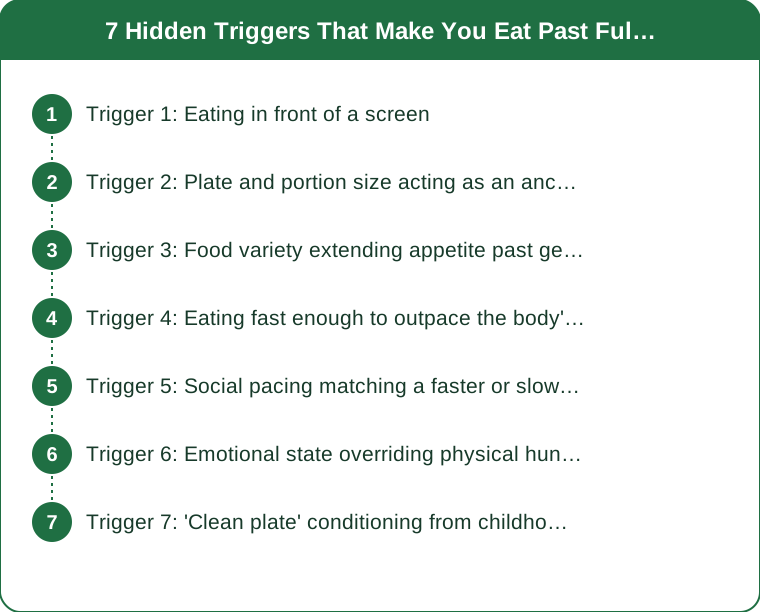
Trigger 1: Eating in front of a screen
Screen distraction measurably delays the recognition of fullness signals, since attention diverted to a show or phone reduces awareness of internal cues that would otherwise prompt stopping. Studies on distracted eating consistently show people eat more total food, and often report feeling less satisfied afterward, compared to eating the same meal without a screen present.
Trigger 2: Plate and portion size acting as an anchor
A larger plate makes an identical portion look smaller, which research on plate-size perception shows reliably leads to people serving and eating more food to visually ‘fill’ the plate to a comfortable-looking level, regardless of actual hunger. This effect happens below conscious awareness, which is exactly why it works so reliably even on people who know about it intellectually.
Trigger 3: Food variety extending appetite past genuine fullness
A wider variety of flavors and textures on the table triggers what’s sometimes called ‘sensory-specific satiety’ delay — the brain’s fullness signal for one specific flavor profile doesn’t automatically transfer to a different one, meaning a dessert course can genuinely still appeal even after a filling savory meal, not because of true hunger but because it’s a novel flavor profile.

Trigger 4: Eating fast enough to outpace the body’s signal delay
Fullness hormones take roughly 20 minutes to fully signal satiety to the brain, and eating quickly means a meal can be finished well before that signal catches up, making it easy to consume more than the body actually needed before the ‘stop’ message arrives. This delay is a fixed physiological lag, not something that varies much by willpower or awareness.
Trigger 5: Social pacing matching a faster or slower eating companion
People unconsciously match their eating pace and portion cues to dining companions, a well-documented social mirroring effect — eating alongside someone who eats quickly or serves themselves generously tends to nudge portions and pace in the same direction, independent of actual personal hunger level.
Trigger 6: Emotional state overriding physical hunger cues
Stress, boredom, and even positive emotional states like celebration can each independently prompt eating that has nothing to do with physical hunger, since food carries strong emotional and reward associations beyond fuel. This trigger is often the hardest to catch in the moment, since it can feel identical to genuine hunger while actually being driven by mood.
Trigger 7: ‘Clean plate’ conditioning from childhood habits
Early conditioning to finish everything served creates a learned behavior that overrides internal fullness cues, since the external rule (‘finish your plate’) was originally prioritized over the internal signal (‘I feel full’) during childhood. This conditioning can persist for decades and often operates completely below conscious awareness during adult meals.
TL;DR:
- Screens, plate size, and eating speed all delay or distort the recognition of genuine fullness
- Food variety and social pacing both extend eating past physical hunger without registering as emotional eating
- Emotional state and childhood ‘clean plate’ conditioning are both powerful, often invisible overeating triggers
- Naming each trigger specifically makes it far easier to notice and interrupt than treating overeating as one vague issue
None of these seven triggers involve a lack of discipline — they’re identifiable, well-documented patterns, and simply knowing to watch for them by name is often enough to catch at least a few of them in the moment.
Keep Reading
This article is for general informational purposes only and is not medical advice. Always consult a qualified health professional for guidance specific to you.