6 Reasons You Eat Fine All Day and Lose It After Dinner
Quick Answer: Evening overeating is usually caused by under-eating earlier in the day, decision fatigue, using food as the only available transition ritual, sleep debt raising hunger hormones, eating while distracted, and treating the evening as a reward for restraint. Fix daytime intake first — it resolves the majority of cases on its own.
You had a good day. Breakfast happened. Lunch was reasonable. You did not graze.
And then somewhere between finishing dinner and going to bed, you ate a second dinner’s worth of things standing up in the kitchen.
The story people tell themselves about this is a character story — willpower runs out, discipline fails. The actual explanations are considerably more mechanical, and every one of them has a lever.

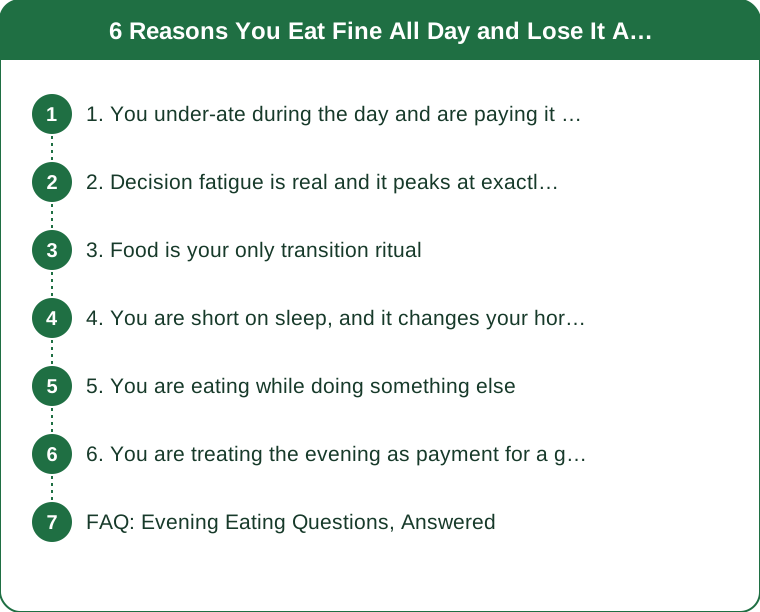
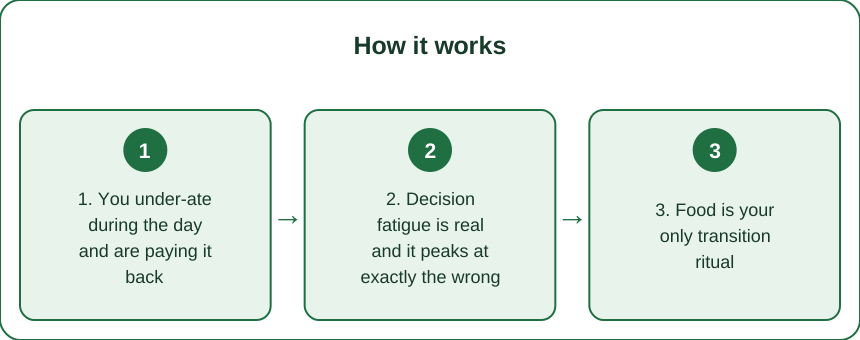
1. You under-ate during the day and are paying it back
This is the largest single cause and the one people most resist hearing.
A day of deliberately light eating creates an energy debt, and the body collects. The collection happens in the evening because that is when the day’s structure — meetings, tasks, being watched — finally stops holding it back.
The tell is specific: if your daytime meals total noticeably less than your evening intake, you are not failing at night. You are being repaid during the only unstructured hours you have.
What to change:
- Add 20 to 30 grams of protein to breakfast. This is the single most effective change most people can make, and its effect shows up 10 hours later.
- Eat an actual lunch, not a placeholder. A salad that leaves you hungry at 3pm is a loan against 9pm.
- Add a genuine afternoon snack around 3 or 4pm with protein and fat. Not fruit alone — that empties too fast to bridge to dinner.
Most people who fix daytime intake find the evening problem shrinks by more than half within two weeks, without addressing anything else on this list.
2. Decision fatigue is real and it peaks at exactly the wrong hour
By 8pm you have made thousands of decisions, and the capacity for deliberate choice is measurably depleted.
Every food decision in the evening costs more than the identical decision at 10am. This is why the same person who effortlessly declined the office donuts is negotiating with a bag of chips nine hours later.
The solution is removing the decision, not strengthening it.
- Decide the evening in advance. Not what you cannot have — what you will have. “After dinner I have tea and two squares of chocolate” is a plan. “I will not snack” is a decision you have to keep re-making all night.
- Pre-portion anything you are going to eat anyway. The portion is decided once, in the morning, by a version of you with capacity.
- Change the default. If something is in the front of the pantry at eye level, you are relying on depleted willpower every single evening. Move it. This is not deprivation, it is friction placement.
Anything you have to decide 15 times in one evening will eventually go the other way, and that is arithmetic rather than weakness.
3. Food is your only transition ritual
The evening needs a marker between doing things and being done, and food is the fastest one available.
For a lot of people, opening the fridge is not about hunger at all. It is the ritual that signals the working part of the day is over — the same role a commute used to play for people who now work from home.
The test: if you notice the urge arrives at a consistent time regardless of what dinner was, it is a ritual, not hunger.
Alternative transitions that actually work because they occupy the same slot:
- A ten-minute walk outside, even a short one. It marks the boundary physically.
- Changing clothes. Underrated. It is a clear signal and it takes 90 seconds.
- Tea, deliberately made. The ritual of making it does most of the work; the tea is close to incidental.
- A shower. The strongest option for people whose evening eating is stress-driven rather than boredom-driven.
The point is not that these are substitutes for food. It is that the slot exists and something will fill it.

4. You are short on sleep, and it changes your hormones
Sleep restriction reliably raises ghrelin and lowers leptin — the hormones that signal hunger and fullness — and it specifically increases appetite for calorie-dense food.
Six hours of sleep versus eight produces measurably higher hunger the following evening, and the effect compounds across a week. This is not a subtle influence. It is one of the most robust findings in appetite research.
The trap is circular: you stay up late, you eat more the next evening, the eating and the screen time push bedtime later again.
Where to break it:
- Set the wake time, not the bedtime. A fixed wake time drags bedtime earlier within about a week without requiring willpower at night, which is exactly when you have none.
- Treat a bad night as information, not failure. If you slept five hours, expect increased hunger tomorrow evening and plan a more substantial dinner rather than a lighter one.
- Notice the pattern across a week. Most people’s worst evenings follow their worst nights with striking consistency, and seeing that on paper is more persuasive than any advice.
5. You are eating while doing something else
Distracted eating produces less satisfaction per calorie, and the effect carries forward into the rest of the evening.
When attention is elsewhere — a screen, a conversation, a task — the meal registers less strongly. Research on this is consistent: distracted eaters eat more during the meal and more at the next one, and they report lower satisfaction from both.
In the evening this compounds because the evening is when most people eat in front of something.
Practical adjustments that do not require eating in monastic silence:
- Eat the first three minutes without the screen. Not the whole meal. Three minutes is enough to register what you are eating, and it is achievable.
- Sit down for anything you eat after dinner. Standing at the counter is where the majority of unnoticed evening eating happens.
- Use a plate, always. Eating from the package removes the only portion signal you have.
- Put the fork down between bites for the first few. It slows the meal by several minutes, which is roughly the lag before fullness signals arrive.
6. You are treating the evening as payment for a good day
This is the one that operates below awareness, and it undermines everything else.
If daytime restraint feels like effort, the evening becomes the compensation for that effort. The better the day, the larger the payment feels justified — which is why people’s worst evenings often follow their most disciplined days.
The structure is self-defeating: restriction earns reward, reward creates guilt, guilt motivates more restriction tomorrow, which earns a bigger reward tomorrow night.
Breaking it requires the daytime to stop feeling like a debit:
- Include something you actually enjoy in every daytime meal. Not as a cheat — as a normal component. A day that feels adequate does not require compensation.
- Stop labeling days as good or bad. The framing itself creates the ledger.
- Eat the thing you want, at dinner, in a normal portion. Foods that are forbidden until 9pm get eaten at 9pm, in a quantity that reflects how forbidden they were.
The most common report from people who make this shift is that the evening urge did not require willpower to overcome — it just became noticeably quieter once the day stopped feeling like a deficit to be settled.
This is general information, not medical advice. If eating feels genuinely out of control or distressing, a registered dietitian or therapist who works with eating behavior is the right resource.
FAQ: Evening Eating Questions, Answered
Is eating at night actually worse for you?
Total intake matters far more than timing for most outcomes. Very late eating can affect sleep quality and digestion for some people, but the reason evening eating gets attention is usually volume and lack of awareness, not the clock itself.
How long does it take for the daytime fix to work?
Most people notice a meaningful difference within one to two weeks of eating more substantially earlier. The change often feels surprisingly passive — the evening urge simply gets quieter rather than requiring you to fight it.
What if I am genuinely hungry at night?
Then eat. Real hunger after a light dinner is a signal, not a lapse. Have something with protein rather than something that empties quickly, sit down for it, and treat it as a meal rather than something that does not count.
TL;DR:
- Under-eating during the day is the number one cause — fix breakfast protein and lunch first.
- Decision fatigue peaks in the evening; remove decisions rather than trying to win them.
- Food is often the only transition ritual available. Give the slot to something else.
- Short sleep raises hunger hormones measurably; a fixed wake time is the practical lever.
- Restriction-as-debt makes the evening a scheduled repayment. Make the daytime feel adequate.
None of these six are willpower problems, which is why willpower has not solved them. Start with the first one — it does the most work, and it is the one that makes the other five easier to address.
Keep Reading
This article is for general informational purposes only and is not medical advice. Always consult a qualified health professional for guidance specific to you.